Baby Play Mats and Gyms: What to Look for at Every Developmental Stage
Match your play gym's features to your baby's current developmental stage for maximum benefit and longevity.
Phase: Infant · Topic: Baby Products · Type: Evergreen · Reading time: ~7 min
Most babies will get bored of a play mat within two minutes — or spend forty minutes utterly absorbed by a single dangling wooden ring. The difference is rarely the baby. It's whether the mat is offering the right kind of stimulation for where their brain and body actually are right now.
A newborn and a six-month-old sitting in front of the same gym are playing completely different games. A newborn is working on tracking a high-contrast shape with their eyes. A four-month-old is trying to figure out if their foot can reach that crinkle square. A seven-month-old is attempting to pull themselves up to sitting using the arch. If your baby keeps seeming bored or frustrated, it's almost always worth asking whether the gym is matched to their stage — not whether your baby is doing something wrong.
What a Play Gym Is Actually Doing for Your Baby's Development
Before choosing a mat, it helps to know what you're buying it for. Physical therapists and occupational therapists frequently recommend play mats for early development because floor time does things that no bouncer, swing, or carrier can replicate.
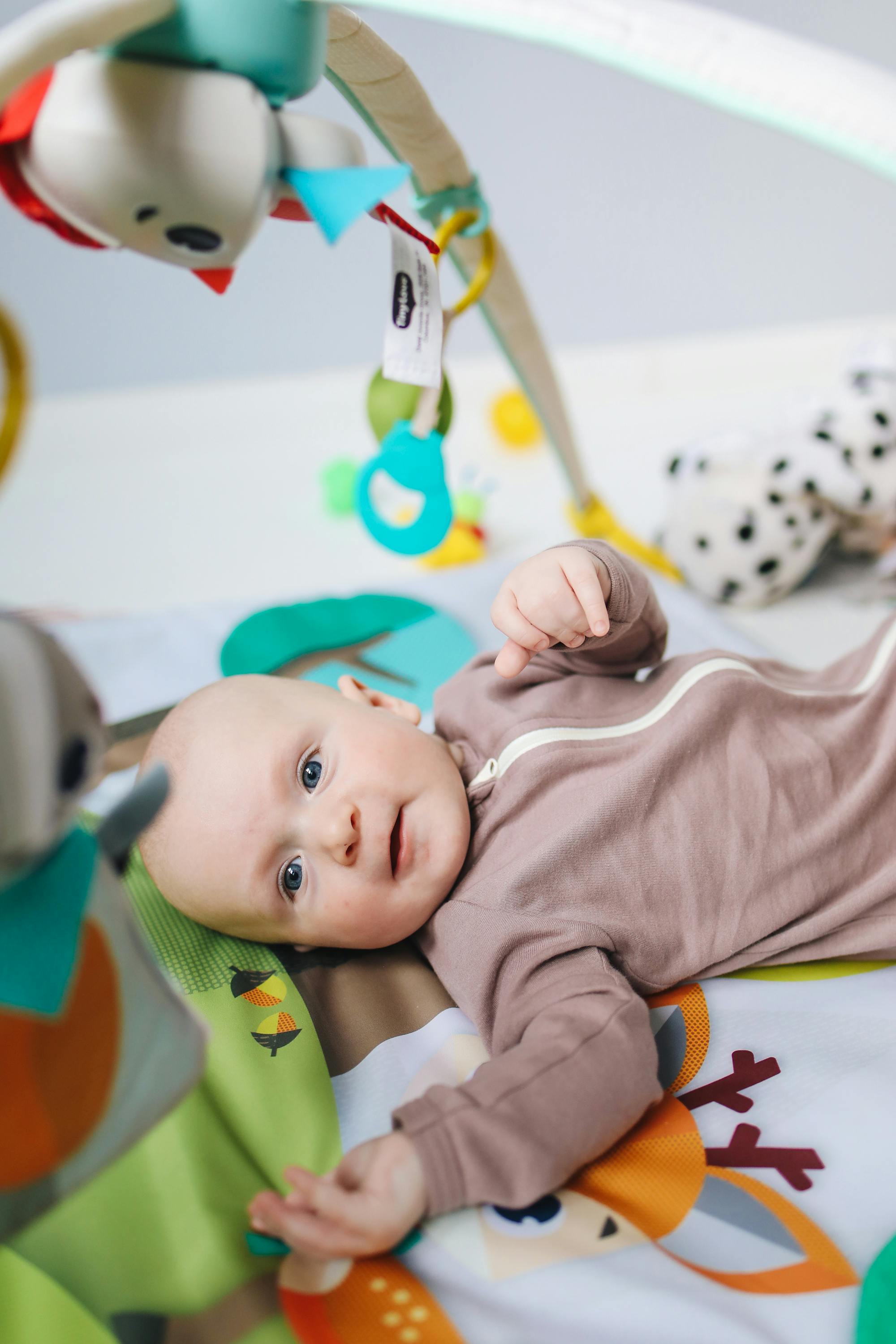
When a baby is on their back under a gym, they're building visual tracking skills (following moving objects), developing hand-eye coordination when they bat at hanging toys, and discovering cause-and-effect — hitting the rattle produces a sound, which triggers another hit. On their tummy, they're strengthening the neck, shoulder, and core muscles that will eventually let them sit, crawl, and walk.
The American Academy of Pediatrics recommends supervised tummy time starting from birth, beginning with short 3–5 minute sessions two to three times per day. The WHO goes further, advising at least 30 minutes of tummy time spread across the day for babies under one year who aren't yet mobile. A well-designed play mat makes this mandatory practice feel like play rather than a chore — both for the baby who hates being on their stomach, and for the parent who has to supervise it.
Stage 1: Newborn to 3 Months — High Contrast is Everything
At this stage, your baby's vision is still developing. Newborns can focus most clearly at a distance of about 8–12 inches — roughly the distance from a nursing parent's face. They're drawn to high-contrast patterns (black and white, or bold primary colors) far more than to pastels or complex images.
What to look for: A mat with interchangeable high-contrast cards or inserts. The Lovevery Play Gym, for example, includes four sets of cards that increase in visual complexity as the weeks pass — starting with simple bold shapes and progressing to faces and color as the baby's visual cortex develops. This isn't a gimmick: it's based on solid research into how infant visual processing works.
Hanging toys should be simple and positioned within arm's reach (roughly 8–12 inches above the chest when the baby is lying on their back) so they can accidentally make contact. At this stage, babies aren't intentionally reaching — but they're noticing the movement when they do.
What you don't need yet: Lights, electronic sounds, or a kicking piano. These are fine to have, but they add zero developmental value in the first weeks. If your mat has them, you'll use them later. For now, a mobile object and a high-contrast card will hold a newborn's attention better than a light show.
Budget-friendly note: A firm, clean blanket on the floor with a few black-and-white picture cards propped nearby is genuinely adequate at this stage. If you want a gym primarily for the newborn phase, you don't need to spend $150 to get value.
Stage 2: 3 to 6 Months — Reaching, Batting, and Kicking
This is when a play gym really starts earning its space. By three months, most babies are developing intentional arm movements — they start trying to hit the hanging toys rather than just touching them by accident. By four or five months, they've figured out that their legs work too, and a kicking piano becomes genuinely engaging rather than random.
What to look for: Hanging toys at varying heights and distances, because your baby is now experimenting with different reach angles. Textures matter here too — soft fabric, smooth silicone, crinkle material, and wood all provide different sensory input that builds tactile awareness. A gym with a mix is worth more than one with five identical plastic rings.
A kicking element — whether it's a piano, a crinkle pad, or a firm ring they can push against — is legitimately useful at this stage for building leg strength and teaching cause and effect. The Fisher-Price Kick & Play Piano Gym (~$45–$55 depending on version) is the budget standard for this feature; it also works as a standalone activity center as the baby grows.
Tummy time upgrades: At this age, a small foam wedge or a rolled towel under the baby's chest makes tummy time far more manageable for babies who resist it. Some mats include a tummy time wedge; others leave you to improvise. Either works.
Worth knowing: By around 4–5 months, many babies can see in full color and in three dimensions. This is a good moment to swap out any newborn high-contrast cards for colorful images, introduce a small mirror (which babies find compelling at this age), and add a new hanging toy with a different texture or sound.
Stage 3: 6 to 9 Months — Sitting Up and Changing the Game
Somewhere around six months — give or take — most babies can sit with support and some are approaching independent sitting. This changes what you need from a play mat entirely.
A traditional arch gym stops making sense as the dominant activity, because a sitting baby can't bat at hanging toys the same way. At this point, the mat itself becomes the primary asset. You want a surface that's large enough for the baby to roll around on (they're probably rolling both ways by now), padded enough to cushion inevitable topples, and washable, because everything is getting chewed on.
What to look for now: A mat with fold-out activity panels around the perimeter — flip-up fabric sections with hidden textures, sounds, or peek-a-boo elements — serves babies at this stage better than toys dangling from arches. The Skip Hop Farmstand Grow & Play (~$90) and the Lovevery Play Gym's flap system both do this well: the hanging gym transforms into a flat floor space with discoverable elements on the edges.
If you're buying for the first time at six months, you don't need a full gym structure at all. A large, padded mat (at least 50x50 inches — babies need the room) plus a few toys placed strategically around the edges will serve them better than a newborn-style arch gym.
Safe material note: This is also the age where everything goes straight into the mouth. Check that any mat your baby is rolling and drooling on has been certified OEKO-TEX® STANDARD 100, or at minimum tested free of phthalates, formamide, and lead. EVA foam — which makes up most cheap puzzle-tile mats — has a mixed safety record; cheaper versions have tested positive for formamide, a known carcinogen. Safer alternatives include TPU foam, XPE foam, or organic cotton with recycled polyester fill.
The Features That Actually Matter Across All Stages
After spending time on these products, a few things consistently separate useful from shelf-collecting:
Washability matters more than almost anything. Babies drool, spit up, and have occasional diaper failures directly on the mat. A mat that requires spot-cleaning only will get disgusting within a week. Look for a machine-washable or wipe-clean surface — and check that the hanging toys are detachable for cleaning too.
Size is underestimated. A mat that's smaller than 36x36 inches will feel cramped by month four. The Skip Hop Silver Lining Cloud and Lovevery Play Gym are both large enough; some cheaper mats (notably the B.toys Starry Sky) have a circular footprint that limits rolling space.
Toy storage on the arch is more useful than it sounds. The ability to add or swap hanging toys lets you keep the gym fresh without buying something new. Velcro loops, removable clips, and O-rings all work. Proprietary attachment systems that only fit that brand's accessories are worth less.
Electronic sounds with volume control — or better yet, no electronics at all — are a genuine preference difference. Some parents find the kicking piano invaluable; others find it triggers overstimulation and a very bad afternoon. If your baby is easily overwhelmed, a gym without battery-powered sounds (like the Lovevery, which uses only mechanical sound elements — a bell, a rattle) may actually work better.
How to Choose Given Your Budget
You don't need to spend $150 to get a developmental play gym. Here's how to think about the price points honestly:
The Lovevery Play Gym (~$150 new, often $80–100 used) is the best all-around option if budget allows — not because of brand prestige, but because its interchangeable card system and five developmental zones genuinely extend useful life from newborn through toddler. It also holds resale value unusually well.
The Skip Hop Farmstand Grow & Play (~$90) is the practical middle choice: large mat, good padding, easy setup and takedown, and a growth chart arch that doubles as a keepsake. Less developmentally thoughtful than Lovevery, but more than adequate.
The Baby Einstein 4-in-1 Kickin' Tunes (~$50) is the budget winner if you primarily want a kicking piano and a gym that converts to a seated activity center. It won't carry you past about seven or eight months, but for the first half-year it does everything it promises.
If spending $30 or less is the ceiling, skip the cheap no-name gyms (they're often undersized and flimsy) and invest in a large padded mat plus three or four quality hanging toys you source separately. An IKEA Lattjo mat or similar plain padded surface with a few good toys clipped on will genuinely outperform a feature-heavy $29 all-in-one.
What This Means for Your Setup
The clearest path: if you're expecting or your baby is under three months, prioritize high contrast and a comfortable tummy time surface, and don't overspend. The gym you buy for a newborn is not the gym you'll be using at seven months — and that's fine, because the needs are genuinely different. A mat that's too stimulating for a three-week-old can become the right environment for a curious five-month-old just by swapping the cards and repositioning a toy.
Check for OEKO-TEX certification or equivalent safety testing before you buy anything a baby will mouth, and make sure whatever you're putting on the floor can be cleaned without a separate trip to a specialist cleaner. After that, the brand name matters far less than whether it fits where your baby is right now.
For ideas on what to do with your baby on the mat — beyond just placing them down and hoping for the best — the gentle activities guide for 0–3 months and sensory play ideas for babies 4–12 months are both worth reading alongside this one.
🌱 Discover Your Parenting Wellbeing Score
Get your personalised score across 9 dimensions and find articles curated for your stage.
Get My Score →Community comment
Sign in to join the conversation and share your parenting experiences.
Sign in with Google
No comments yet — be the first to share your thoughts! 💛