The Best Baby Bouncers and Rockers That Actually Soothe a Fussy Infant
The BabyBjorn Bouncer Bliss is the most reliable all-around bouncer; the 4moms mamaRoo suits babies who need motorised motion variety. No inclined product should ever be used for unsupervised sleep.
Phase: Infant · Topic: Baby Products · Type: Evergreen · Reading time: ~7 min
Every parent arrives at the same moment eventually: you have been holding a baby for six hours, your arms ache, you would like to eat something, and the second you put them down they cry. The bouncer or rocker is the category of baby gear designed specifically for this problem. When it works — when your baby settles into it, looks around at the ceiling, and gives you fifteen minutes of actual quiet — it is one of the most useful purchases you will make. When it does not work, it is a $250 item that sits in the corner.
The frustrating truth is that which kind works depends almost entirely on the baby. Some infants want motion that responds to their own movement; others want a motorised seat that keeps going regardless. Some need the specific gentle arc of a particular swing; others will only settle on a flat bouncer with white noise. Your baby has not read any of the reviews. This guide helps you understand the underlying categories, what the safety rules actually are (they matter more here than in almost any other baby product category), and which specific products have the strongest track records across a range of babies.
The Safety Foundation: What You Need to Know Before Buying Anything
This category has more product safety history than almost any other in the baby gear market. Understanding it takes two minutes and protects your baby.
Inclined sleepers are dangerous. The Fisher-Price Rock 'n Play — once the best-selling infant product in America — was recalled in 2019 after being linked to over 100 infant deaths. Babies rolled from their backs to their stomachs in inclined, restrained positions and could not recover. A 2023 CPSC statement confirmed approximately 100 deaths in the Rock 'n Play, including deaths that occurred after the recall. Separate recalls followed for Kids2 Rocking Sleepers (15 deaths) and Fisher-Price's own 4-in-1 Rock 'n Glide Soothers (4 deaths).
The AAP position is clear: no inclined sleep product is safe for unsupervised infant sleep. Babies must sleep on a flat, firm surface on their backs.
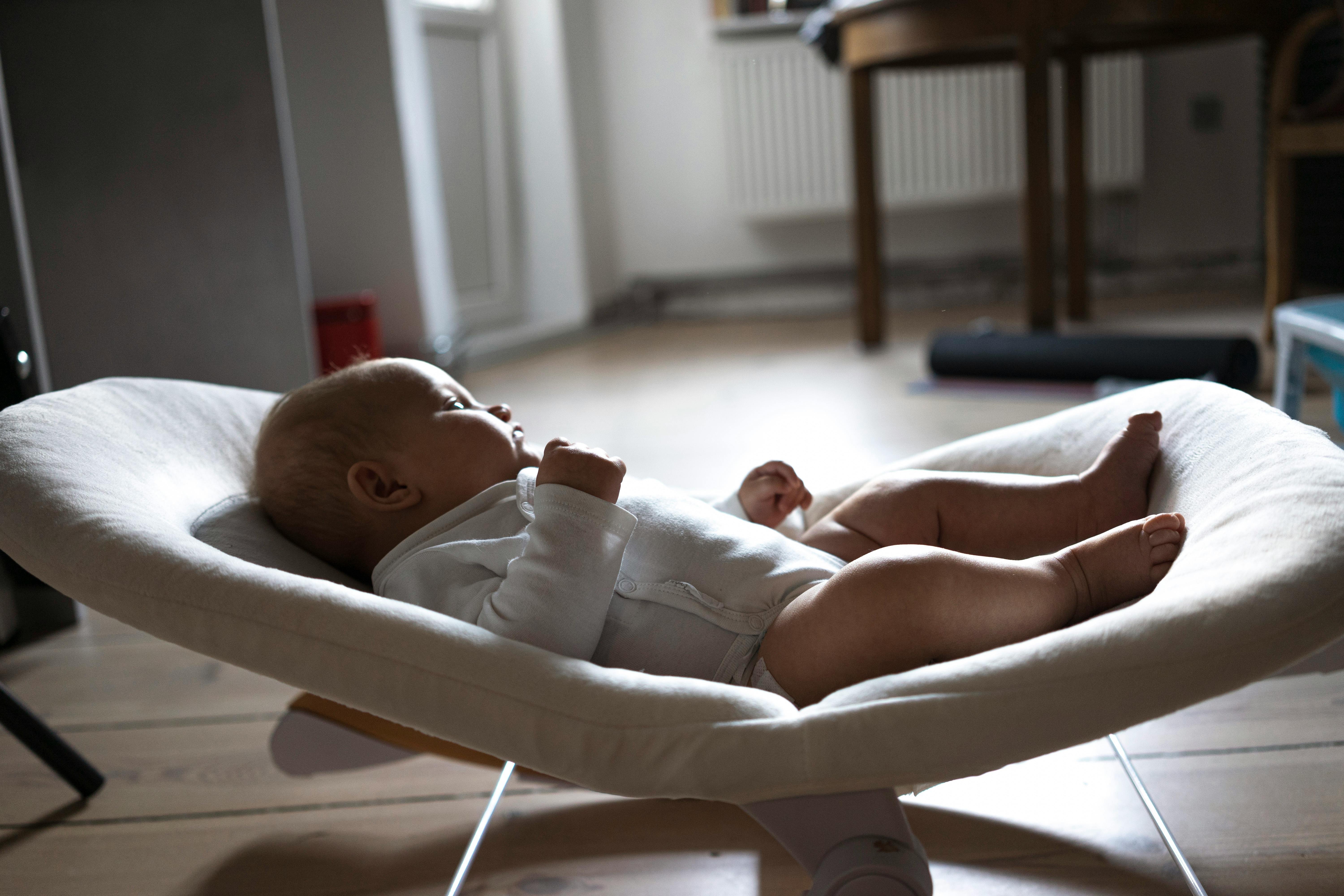
The key rule for any bouncer or rocker: these are supervised awake products, not sleep surfaces. When your baby falls asleep in a bouncer, transfer them to a crib or bassinet. Do not leave them asleep and unattended in any bouncer, swing, or rocker. This is the rule that protects against the majority of serious incidents in this category.
Harness matters. Any seat for babies under six months should have a five-point harness (crotch strap plus shoulder straps plus waist straps). A three-point harness is the minimum, but the five-point is strongly preferred. The 2022 mamaRoo recall — 2 million units, linked to one death and one injury — was specifically for older models with three-point harnesses where cord entanglement occurred. Current MamaRoo models use five-point harnesses and are not included in that recall. If you are buying second-hand, always check the recall status.
With that foundation in place, here is what the market actually offers.
Bouncer vs. Rocker vs. Swing: What Is the Difference
Bouncers (like the BabyBjorn Bouncer Bliss) respond to the baby's own movements — a kick or a wiggle sends the seat moving, which teaches cause-and-effect, rewards movement, and does not require power. Lightweight, portable, and no running costs.
Rockers (like the Nuna Leaf) have a set arc of motion that you initiate with a push, or that runs motorised on a timer. The Nuna Leaf specifically is non-motorised — a push keeps it moving for about two minutes. Motorised rockers maintain continuous motion without input.
Swings (like the 4moms mamaRoo) are motorised and offer a wider range of motion types — side to side, front to back, figure-of-eight, circular, and combinations thereof. Typically the largest, heaviest, and most expensive category. Designed for babies who need more motion variety to settle.
Most parents end up needing to try their baby in one before committing. The best second-hand baby item to buy first is a bouncer, because they are cheap, clean up easily, and give you a sense of what motion your baby responds to before you invest in a swing.
The Five Products Worth Knowing About
BabyBjorn Bouncer Bliss — ~$210–$260
The BabyBjorn Bouncer Bliss is consistently the highest-rated bouncer across independent testing and has maintained that position for years. It weighs 4.6 lbs, folds completely flat, requires no batteries, and the cover is machine washable. The motion responds directly to the baby's movements — a kick bounces the seat, which babies tend to find satisfying and regulating from around four to six weeks onward.
The ergonomic shape is genuinely different from cheaper bouncers: the seat cradles the baby at a slight incline in a way that provides head and neck support without the dangerous recline angle of inclined sleepers. Three position settings let you adjust from fully reclined (for newborns) to more upright (for older babies watching the world).
Its limitation is that it is a passive system. If your baby only settles with consistent, motorised motion and does not respond to their own movements, the Bouncer Bliss will not solve that problem. But for the majority of babies who simply need something to lie in while you have both hands, it is the most reliable option at this price.
Best for: Newborns through around 8 months, families who want portable and zero running costs, babies who respond to their own movement.
Price: ~$210–$260 new; frequently $120–$150 secondhand.
4moms mamaRoo Multi-Motion Swing — ~$200–$240
The mamaRoo offers five motorised motion types — car ride, kangaroo, tree swing, rock-a-bye, and wave — each at five speed settings, giving 25 possible combinations. For babies who need variety, or who settle specifically in one motion type that no manual bouncer can replicate, this range genuinely matters. The "car ride" motion in particular has a devoted following among parents of babies who are otherwise impossible to settle.
The trade-offs are weight (it is heavy and not particularly portable), footprint (it takes up meaningful floor space), and the reality that some babies simply hate it regardless of which motion you select. Parent communities consistently report the full range from "this saved our sanity" to "expensive doorstop that our baby refused from day one." The Bluetooth app is a convenience feature, not a necessity.
Important note on recall: Earlier mamaRoo models (versions 1.0 through 4.0 with three-point harnesses) were recalled in August 2022. Current models use a five-point harness and are not subject to that recall. If buying second-hand, verify the model number against the recall list.
Best for: Babies who need motorised motion variety, parents willing to invest in the feature set to find what their specific baby responds to.
Price: ~$200–$240 new; $80–$130 secondhand (verify recall status on older models).
Nuna Leaf Grow — ~$200–$220
The Nuna Leaf occupies an unusual position in this category: it is a non-motorised rocker with a gentle pendulum arc that you set in motion with a push, and it continues for around two minutes. That simplicity is its selling point — there is nothing to break, no battery to run out, and no motor noise. The seat converts from an infant rocker (with harness insert) to a toddler chair with a 130-lb weight limit, which is an unusually long useful life for this category.
Its limitation is the same as the BabyBjorn: if your baby needs consistent, continuous motorised motion, a two-minute gentle arc will not be enough. The Leaf also does not fold for easy transport.
Best for: Families who want a long-lasting, low-maintenance seat; babies who settle in gentle non-motorised motion.
Price: ~$200–$220.
Fisher-Price Snugapuppy Bouncer — ~$60–$75
For families who want to test the bouncer concept without committing significant money — or who need a second unit for grandparents' house — the Fisher-Price Snugapuppy is the reliable budget option. It has vibration mode, plays music, and has a calming overhead toy bar. The calming scores in independent testing (Mommyhood101 specifically tests for actual soothing effectiveness) are consistently solid at this price point.
Its limitations are obvious: the vibration is not as smooth as premium options, the fabric is harder to clean, and it will not last as long. But for under $75, it reliably gives you a place to put a baby that is not your arms.
Best for: Budget-conscious families, grandparent/second homes, trying the bouncer concept before investing in premium options.
Price: ~$60–$75.
Ingenuity ConvertMe Swing-2-Seat Portable Swing — ~$90–$110
The Ingenuity ConvertMe represents the sweet spot for parents who want motorised motion without the mamaRoo's price or footprint. It converts from a full-size swing to a more compact portable seat, runs on AC or batteries, and offers multiple motion types and music settings. It does not offer the motion variety of the mamaRoo, but it covers the most commonly effective patterns — front-to-back and side-to-side — at roughly half the price.
Best for: Families who want motorised motion on a mid-range budget, smaller spaces, portability between rooms.
Price: ~$90–$110.
What Actually Determines Whether Your Baby Likes It
The most honest advice in this category: no product review can tell you whether your specific baby will settle in any given bouncer or swing. What the reviews can tell you is which products are well-made, which are safe, and which have the highest hit rates across the broadest range of babies.
The BabyBjorn Bouncer Bliss has the highest hit rate for manual bouncers. The mamaRoo has the highest hit rate for motorised swings — but also the most parents who report buying a $240 item their baby rejected completely.
Two practical strategies: buy the BabyBjorn first (it works for most babies and has strong secondhand resale value if yours hates it), and only add a swing if you find your baby needs more continuous motion. The families who end up with both a bouncer and a swing are common; it is a reasonable backup plan. The families who spend $250 on a swing as their only item and find their baby prefers a $60 bouncer are also common.
For the broader sleep and settling context, safe sleep rules every new parent needs to know covers the full AAP framework. And if the fussiness is persistent and severe enough that nothing seems to settle your baby, how to survive the first month of parenthood addresses that honestly.
🌱 Discover Your Parenting Wellbeing Score
Get your personalised score across 9 dimensions and find articles curated for your stage.
Get My Score →Community comment
Sign in to join the conversation and share your parenting experiences.
Sign in with Google
No comments yet — be the first to share your thoughts! 💛