The Power of Family Routines: Why Predictability Makes Kids Feel Safe
Consistent family routines reduce children's anxiety, build emotional regulation, and improve sleep — without requiring a perfect schedule.
Phase: Family · Topic: Family Wellness · Type: Evergreen · Reading time: ~8 min
Children with a consistent bedtime routine sleep, on average, more than an hour longer per night than children with no routine at all. That finding — from a study of over 10,000 families across 14 countries — isn't really about sleep. It's about what the brain does when it knows what comes next.
This is the core of why family routines work: not because they impose order, but because they remove a specific kind of low-grade stress that children carry when their environment is unpredictable. And most parenting advice about routines skips this entirely, jumping straight to morning charts and laminated schedules without explaining the neuroscience underneath.
Your child's brain is doing threat math all day long
A child who doesn't know whether tonight will be chaotic or calm, whether dinner is happening at five or eight, whether bedtime means a story or a battle — that child's brain is quietly, continuously scanning for threats. Not in a dramatic way. Just a steady background hum of uncertainty.
Child development researchers describe this state as "ambient anxiety," and it has real cognitive costs. When the nervous system is occupied with threat-monitoring, there's less capacity available for learning, emotional regulation, and social connection. It's not a character flaw or a parenting failure — it's basic neuroscience. The brain prioritises safety over everything.
Consistent routines interrupt that cycle. When a child can reliably predict that after dinner comes bath, then books, then bed — that sequence itself becomes a signal that the world is safe. The threat-monitoring quiets down. The cognitive resources that were tied up in uncertainty get redirected toward development.
A 2024 systematic review in the Journal of Family Theory & Review traced this directly to attachment theory: daily routines like feeding and play foster secure attachments precisely because they provide the regularity and predictability that help infants and young children build trust in their caregivers. Predictability isn't a parenting technique — it's how children learn that the people around them are reliable.
Routines don't just help children sleep. They help children regulate.
The sleep research is where the numbers are most striking, but the effects extend well beyond bedtime. A 2023 study of 1,515 elementary school children in Japan found that family routines significantly reduced both internalising and externalising problem behaviours — anxiety, withdrawal, aggression — and that this happened largely through their effect on family cohesiveness and expressiveness. In other words, routines don't just manage behaviour; they shape the emotional quality of the whole household.
Separate research in children from low-income families found that routines moderated cortisol levels — the body's primary stress hormone — and supported better emotion regulation even in contexts of significant external stress. The structure of the day became a buffer against instability outside the home. That's a remarkable finding: a predictable mealtime and a consistent bedtime don't just make the evening easier to manage. They provide biological protection against stress.
This is also why routines benefit children who are going through transitions — a new school year, a house move, a new sibling. The routine is the part of daily life that hasn't changed. It acts as a reference point when everything else is uncertain.
Building emotional resilience in your children works on a similar principle: the security that comes from consistency allows children to develop the internal resources to handle challenge. Routines are one of the most accessible ways to build that foundation.
The rigidity trap (and how to avoid it)
Here's where most advice about family routines goes wrong: it presents them as schedules. Precise, colour-coded, laminated-on-the-fridge schedules. And when real life doesn't cooperate — when someone gets sick, when work runs late, when the school play throws off Wednesday entirely — the schedule collapses and parents feel like they've failed.
But the research doesn't show that rigid schedules produce good outcomes. It shows that predictable sequences do. The difference matters.
A sequence — bath, then books, then bed — holds even if bath happens at 7:15 one night and 7:45 the next. What the child's brain registers is the order of events, not the clock. Psychologist Laura Markham describes this well: children feel less "pushed or bossed around" when a routine is established, because the activity becomes "just what we do at this time of day." The resistance drops not because the parent enforces the schedule harder, but because the child stops experiencing it as an imposition and starts experiencing it as the predictable shape of the day.
This also means that when routines break — as they will — the goal is simply to return to them. Not perfectly, not immediately, not with a family meeting. Just to get back to the sequence. Children are remarkably adaptable to occasional disruption when the baseline is stable. It's chronic unpredictability that creates the anxiety; a missed bedtime routine on a special occasion is barely registered.
Which routines actually move the needle
Not all routines are created equal, and you don't need a jam-packed schedule to see real benefits. The research consistently highlights a handful of specific contexts where predictability produces the most measurable outcomes.
Bedtime. The evidence here is the most substantial. Consistent bedtime sequences — bath, teeth, books, lights out — improve sleep onset, reduce night wakings, and are associated with better executive function and school readiness. Children in families with optimal bedtime routines score higher on tests of working memory, inhibition, and cognitive flexibility. Their parents, it turns out, report lower anxiety and higher relationship satisfaction too. A good bedtime routine pays dividends across the whole household.
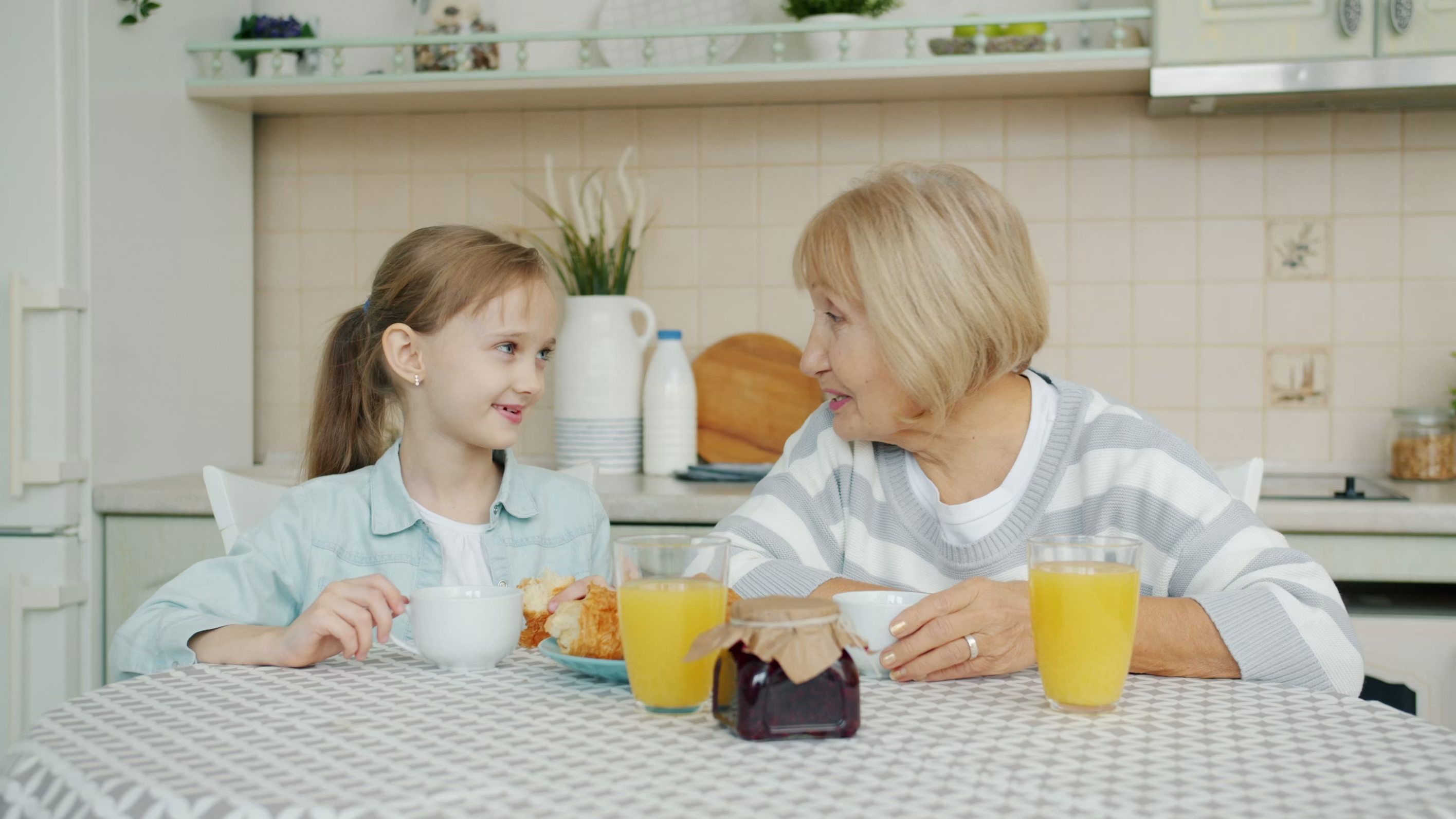
Mealtimes. Research across thousands of children consistently identifies shared family meals as one of the most protective routines a family can build. The effect isn't purely nutritional. It's the predictable connection — the same table, the same faces, the reliable opportunity to talk — that matters developmentally. Screens off and everyone present, even imperfectly and even briefly, is enough.
Morning sequences. Mornings are where routine breakdown is most costly, because the consequences cascade into the school day. A stable morning sequence — the order in which things happen, not necessarily the exact time — reduces the cortisol spike that comes from rushing and conflict. A well-structured morning routine also builds children's independence over time, as they internalise the sequence and stop needing to be reminded of every step.
After-school transitions. The hour after school can be a flashpoint — children are often emotionally depleted after a day of social regulation and learning demands. A predictable after-school rhythm (snack, free time, then homework) gives them a decompression sequence. Without it, homework battles are more common precisely because children are being asked to shift to task-mode without any buffer.
Worth knowing: A 2025 study found that inconsistent bedtime routines and parenting stress have a bidirectional relationship — inconsistent routines increase stress, and higher parenting stress makes routines less consistent. Starting small with a single, stable sequence (even just the bedtime routine) can break that cycle in both directions.
Building a routine that survives real life
The version of family routines that works is simpler than most advice suggests. It doesn't require a new app, a visual schedule for every room, or a Sunday planning session. It requires deciding on a sequence and repeating it.
Start with one anchor point — usually bedtime, because the sleep benefits are immediate and reinforcing. Decide on three to five steps, in order, that happen every night. They can be quick: a bath isn't required. Teeth, a short read, a brief connection ritual (one good thing from the day, or a specific song) is enough. Do that sequence in that order for two weeks before adding anything else.
For mornings, work backwards from the time the household needs to leave or begin. Identify the three things that reliably cause chaos — usually locating shoes, packing bags, or getting a slow mover dressed — and move those to the night before. Then the morning sequence is just wake, eat, dress, go. In that order, every day.
Involve children in designing the routine from about age four or five. Not to give them veto power over bedtime, but to let them have input on how the sequence runs. This reduces resistance considerably and builds a genuine sense of ownership over their own daily rhythm.
Creating a calm home environment is partly about physical space, but more fundamentally it's about temporal predictability — the sense that the day has a shape and that the shape is reliable.
What this means for your family
The most useful reframe here is this: family routines are not about discipline or control. They are about safety. When a child knows what comes next, their nervous system settles. When their nervous system settles, they learn better, behave more cooperatively, sleep more soundly, and handle disruption more gracefully.
You don't need a perfect routine. You need a consistent one. Pick one sequence — bedtime is the highest-leverage starting point — establish the steps, repeat them, and give it three weeks before judging whether it's working. The first week will be rough. The second will be easier. By the third, the child will often remind you what comes next.
That moment — when your four-year-old announces it's time for books before you've said a word — is the routine doing exactly what it's supposed to do.
🌱 Discover Your Parenting Wellbeing Score
Get your personalised score across 9 dimensions and find articles curated for your stage.
Get My Score →Community comment
Sign in to join the conversation and share your parenting experiences.
Sign in with Google
No comments yet — be the first to share your thoughts! 💛