Gentle Activities You Can Do With a Newborn in the First 3 Months
Talking, skin-to-skin contact, tummy time, and high-contrast visuals are the most developmentally powerful things you can do with a newborn in the first three months.
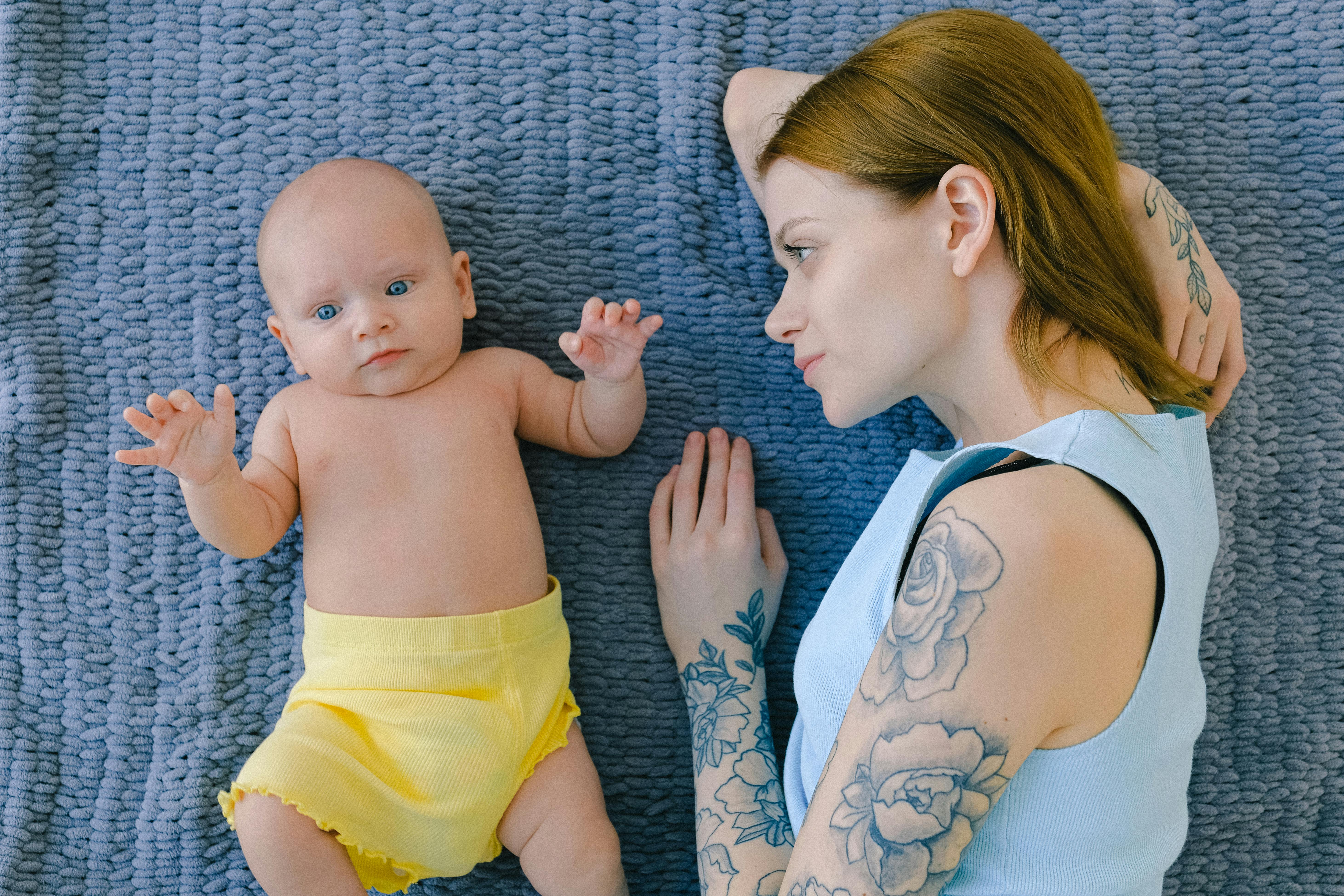
Phase: Newborn · Topic: Family Activities · Type: Evergreen · Reading time: ~7 min
Most new parents stare at their newborn at some point in week two and think: I have no idea what to do with you. There is a baby in your arms who mostly eats, sleeps, and stares at the ceiling — and every parenting book is either telling you to cherish every moment or selling you a developmental toy set. Neither is particularly useful.
Here is what is actually useful: newborns in the first three months are building the architecture of their brains at a rate that will never be matched again. And the activities that support that process are mostly free, require no special equipment, and look a lot like just being with your baby. This is not a list of ways to entertain a newborn. It is a guide to what your baby's developing brain and body actually need right now — and how to deliver it without burning yourself out.
What Your Newborn Can Actually Perceive (It Affects Everything You Do)
Before getting into specific activities, it helps to understand what your baby can and cannot sense in the first three months — because it changes which interactions are worth your energy.
Vision: Newborns can focus most clearly on objects 8 to 12 inches from their face — roughly the distance between your face and theirs when you are holding or feeding them. That is not a coincidence; it is evolution. They see the world mostly in shades of grey and high-contrast edges. Full colour vision develops gradually, with most babies beginning to distinguish primary colours around three to four months.
Hearing: Hearing is essentially complete at birth. Your baby already knows your voice — they have been listening to it in utero for months. They are particularly attuned to the exaggerated, higher-pitched speech patterns that researchers call "parentese": the slow, melodic, face-to-face talking most parents instinctively do.
Touch: The most developed sense at birth. Skin-to-skin contact directly regulates your baby's heart rate, temperature, cortisol levels, and nervous system. A systematic review published in NCBI (2021) confirmed that skin-to-skin contact reduces infant stress response measurably through biological markers including cortisol and oxytocin.
Understanding this tells you something important: the most powerful newborn activities are the ones that work within these sensory limits — face close, voice steady, touch consistent.
Tummy Time: Non-Negotiable, But More Flexible Than You Think
Tummy time is the most evidence-backed activity for newborn development, and the one most parents are told to do without being told how to do it when their baby screams the moment they try.
The AAP recommends building toward 15 to 30 minutes of tummy time per day by seven weeks of age — but critically, this does not mean a single session on the floor. For a newborn, starting with one to two minutes several times a day across each wake window is both safe and effective, according to research from the University of Alberta (2023) which found that babies getting recommended tummy time hit gross motor milestones measurably earlier.
When your baby hates it — which is common, especially in the first few weeks — try these alternatives that count as tummy time:
- Chest-to-chest tummy time: Recline slightly and place your baby tummy-down on your chest. Same muscle groups, more comfort, more eye contact.
- Across-the-lap: Place baby face-down across your thighs while you sit. The slight curve supports their body and can help with gas.
- Tummy time on a rolled towel: A small rolled towel under the chest takes pressure off the face and makes it easier for early head lifts.
By week six or eight, most babies begin to tolerate floor tummy time better. A high-contrast book propped open in front of them is often enough to hold their attention through the discomfort. By three months, the goal is roughly 20 to 30 minutes per day broken across multiple sessions.
Talk to Your Baby — More Than Feels Natural
This one feels obvious until you try it at 11am with a three-week-old who is staring at the wall, and you run out of things to say within 90 seconds.
The research is clear: early language exposure is one of the strongest predictors of vocabulary and communication skills at age three and beyond. Babies learn language from hearing it before they can produce it, and the talking you do now is wiring those neural pathways. The Mayo Clinic specifically names simple conversation — making eye contact, changing tone of voice, reacting to coos — as foundational for language development from the newborn stage.
The most practical approach is narration. Just describe what you are doing. "Now I am changing your nappy. This is a clean one — it is warm. Now I'm doing up the poppers. One, two, three." Your baby does not need you to be interesting. They need to hear your voice making the patterns of language. If you run out of steam, read anything aloud — a news article, a recipe, a page of whatever you are reading. The content is irrelevant; the prosody is everything.
Parentese — that instinctive sing-song, slightly slower, more expressive way of talking to babies — is not silly. It is precisely calibrated to what the infant auditory system responds to best, and babies track it more closely than normal adult speech.
High-Contrast Visual Play
Your baby's visual cortex is hungry for input, and in the first two months it processes high-contrast black-and-white images better than anything else. Bold stripes, checkerboard patterns, simple geometric shapes, and close-up human faces are all highly stimulating for a developing retina.
You do not need to buy anything for this. Print or draw simple black-and-white patterns on card stock and hold them 8 to 12 inches from your baby's face during alert wake windows. A black-and-white striped sock drawn on white paper takes three minutes to make and will hold a newborn's attention longer than a pastel mobile.
From about six weeks, babies begin to track moving objects. Slowly moving a high-contrast card or your face side to side during alert time encourages the eye muscles to work together and begins building the neural connections for visual focus. By three months, most babies can follow a moving object in a smooth arc.
For tummy time specifically, propping a high-contrast book open in front of your baby at face level serves double duty: it provides visual stimulation and gives them a reason to lift their head.
Skin-to-Skin and Babywearing: The Activity That Counts When You Have No Energy Left
There will be days — many of them — where you cannot manage tummy time or narration or visual play. You are exhausted and the baby is fussy and everyone just needs to get through the next hour. On those days, skin-to-skin contact and babywearing are legitimate developmental activities, not just survival tactics.
Research links skin-to-skin contact with improved stress regulation, stronger attachment, better breastfeeding outcomes, and — in a 2024 study of preterm infants — measurable differences in white matter development in the brain. The mechanism is contact itself: warmth, heartbeat, familiar scent, and rhythmic movement all signal safety to an immature nervous system.
Babywearing extends this through the day. Studies have found that carried babies cry up to 43% less during the day and around 51% less in the evenings. The upright position helps with reflux. The rhythmic movement regulates cortisol. And because your hands are free, you can also narrate, which means two developmental activities at once.
Worth knowing: Any carrier is fine as long as it keeps your baby in the TICKS position — Tight, In view at all times, Close enough to kiss, Keep chin off chest, Supported back. Structured carriers, ring slings, and stretchy wraps all work safely when used correctly. See the best baby carriers for every body type and budget for a guide to choosing one.
Singing, Music, and Movement
You do not need to be a good singer. Newborns are not critics. Songs — especially ones with repetitive rhythms, simple melodies, and your voice — activate the auditory system and reinforce the language pathways that narration also builds. The added physical element of gentle swaying or rocking adds vestibular input, which supports balance and spatial awareness development.
Songs with predictable patterns work particularly well because babies begin anticipating the rhythm. That anticipation is a form of early cognitive learning. Nursery rhymes, folk songs, pop songs you actually like — all of it works. The genre matters less than the consistency and closeness.
If your baby is in an alert, calm state — what you will come to recognise as the sweet spot between feeding and sleeping — this is a good window for a few minutes of face-to-face singing, gently cycling their legs to the beat, or holding them upright to look around the room while you describe what you see.
What Actually Counts as Play at This Age
The common thread through all of these activities is this: play in the first three months is not about entertainment or enrichment. It is about co-regulation — a calm, present adult helping an immature nervous system learn to process the world safely. Your face, your voice, your heartbeat, and your hands are the most sophisticated developmental tools available to a newborn. The research consistently confirms that the right mix of tummy time, reading, and sleep hits developmental motor milestones earlier — not expensive toys, not curated activity schedules.
That means three genuinely good tummy time sessions, some narrated nappy changes, a few minutes of face-to-face talking during the alert window, and a good stretch in the carrier counts as a developmental-rich day. You do not need to do more than that. And on the days where all of that felt impossible, skin-to-skin on the sofa still counts.
When your baby moves into the four-to-twelve-month stretch, the activity repertoire expands significantly. Sensory play ideas for babies 4–12 months old has a full guide to what comes next. And if you are wondering how to structure the day around sleep, newborn sleep schedules: what's normal and what isn't helps with the timing that makes these activities easier to fit in.
🌱 Discover Your Parenting Wellbeing Score
Get your personalised score across 9 dimensions and find articles curated for your stage.
Get My Score →Community comment
Sign in to join the conversation and share your parenting experiences.
Sign in with Google
No comments yet — be the first to share your thoughts! 💛