The Best Free and Low-Cost Outings for Toddlers in Any City
A practical guide to free and low-cost toddler outings that work in any city, including the membership hack that makes children's museums nearly free.
Phase: Toddler · Topic: Family Activities · Type: Evergreen · Reading time: ~8 min
Here is the thing about outings with toddlers that nobody tells you before you have one: the destination matters far less than the change of scene. A toddler who has been looking at the same four walls for three days will find a car park interesting. The bar for a successful outing at this age is genuinely low — and that means you do not need to spend money to meet it.
The best free and low-cost outings for toddlers are also, reliably, the ones that work with how toddlers actually experience the world: slowly, physically, and with total absorption in whatever is immediately in front of them. This is not a limitation. It is an advantage. A hardware store is fascinating to a 2-year-old. So is a post office, a pet shop, a fire station, and a farmers market. You are not failing to take them somewhere impressive. You are going places where the world is genuinely on display.
This guide covers the free and low-cost outings that hold up across cities and seasons — including one membership strategy that most parents do not know about, and that makes children's museums nearly free for families who use it correctly.
The Library: The Most Underused Free Resource in Any City
Every public library in the United States and United Kingdom runs free toddler programming, and most parents use it far less than they could. The standard offer is a weekly storytime for under-5s — typically 20–30 minutes of books, songs, fingerplays, and movement, followed by free play with educational toys. No booking required at most branches. No cost. No pressure to buy anything.
The developmental case for library storytime is solid. Research published in the journal Scientific Studies of Reading found that shared reading and early literacy activities in the preschool years consistently predicted cognitive and school competencies six years later. The library storytime distils this — books, rhymes, repetition, vocabulary exposure, social interaction with other children — into a single free weekly session that most families could walk to.
The hidden benefit is the people. Library storytimes are where parents in the same stage meet each other, which matters more than it sounds. The social isolation of the toddler years is real, and a recurring free weekly outing builds the kind of low-stakes regular contact that becomes support. For building this into a daily reading practice at home, building a home reading habit with preschoolers covers the specific techniques that transfer from library visits to the bookshelf at home.
How to find it: Search "[your city/town] public library toddler storytime." Most library websites list sessions by age group. Many branches run multiple sessions per week.
Splash Pads and Spray Parks: Free Water Play Without the Pool
Most cities and large towns have at least one publicly funded spray park or splash pad — a ground-level water feature with jets, sprays, and streams that toddlers can walk, run, and splash through without any depth risk. In the US, these are almost universally free. In the UK, equivalent paddling pools and water play areas in public parks are free to use.
For toddlers who are not yet confident swimmers, splash pads are ideal: there is nothing to fall into, no depth, no current. All the sensory delight of water play — the cold jets, the squealing, the running — without the supervision intensity of a pool. The NAPA Center notes that running through water jets specifically stimulates the vestibular system, which governs balance and spatial awareness, in ways that indoor play cannot.
How to find it: Search "[your city] free splash pad" or "[your city] spray park." In the UK, search "[your town] paddling pool park." Most local authority parks departments list these on their websites.
Farmers Markets: The Toddler Sensory Tour You Did Not Know You Were Taking
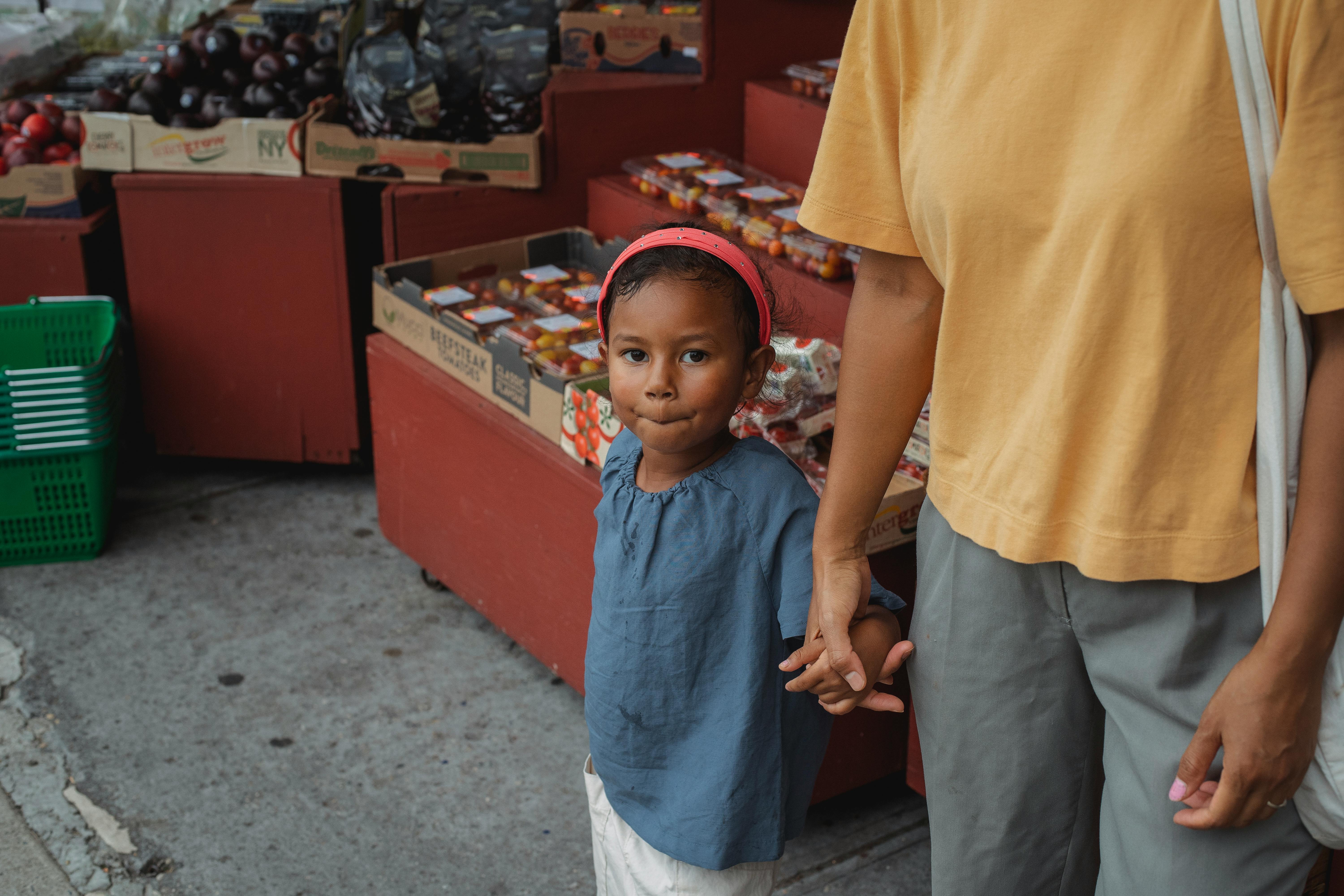
A farmers market is one of the best free toddler outings in existence, and almost no parenting article mentions it because it does not feel like a "children's activity." It is. The colours, textures, smells, and sounds are rich in a way that indoor play spaces cannot replicate. A toddler running a hand along a basket of peaches, watching a man slice watermelon, hearing a busker three stalls down — this is full-body sensory input.
The practical structure is good too. A farmers market is outdoors and open-ended: your toddler can walk slowly without blocking anything, stop to stare at something for three minutes, and back-track without inconveniencing anyone. Bring one small cloth bag and let them choose one item to carry home. The ownership and the narrative ("you chose the tomatoes") go a long way.
How to find it: Search "[your city] farmers market" — most run weekly on weekend mornings. In the UK, local authority websites and localfooddirectory.co.uk list markets by postcode.
The Hardware Store: Underrated Toddler Goldmine
This one sounds like a joke. It is not. A large hardware store — a Home Depot, B&Q, Lowe's, Screwfix — is one of the most engaging free outings for a toddler who is verbal enough to ask questions. There are machines that move. Pipes in every conceivable size. Tiles and countertop samples in dozens of textures. Paint colour swatches in every colour humans have named. Small fixings in little bins.
The developmental framing: hardware stores are packed with opportunities for classification, comparison, and early maths language ("this one is longer / heavier / rougher than that one"). They also require a toddler to walk beside you and use their words, which is different from the free-roaming nature of parks and playgrounds.
A few parents in r/toddlers and r/Parenting have independently discovered that paint sample cards — free from any DIY store — are some of the best sorting and colour-matching materials available, completely free, and far more durable than anything you can print at home.
The Pet Store: Free Zoo, Conveniently Located
Pet stores exist in every city and charge nothing to walk around. The fish tanks, the birds, the small mammals in enclosures, the reptiles — this is a legitimately engaging visit for any toddler who is interested in animals. Which, at this age, is almost all of them.
The language opportunity is significant: naming animals, describing what they look like, watching their behaviour and narrating it ("the fish is swimming to the top, now it's going back down") — this is exactly the kind of back-and-forth conversational exchange that research consistently identifies as the highest-return language-building activity for toddlers. No toys required. No prep. Usually twenty minutes to half an hour of genuine engagement.
A note: Some pet stores do not want toddlers handling the animals. Ask at the desk before any touching, and set expectations before you walk in that this is a looking visit, not a touching one.
Children's Museums: The Membership Hack That Changes the Maths
Children's museums charge entry fees that can feel steep for a single visit — typically $10–$20 per person in the US, £5–£12 in the UK. But most families do not know about the reciprocal admission networks that make membership dramatically more valuable.
In the US, the Association of Children's Museums (ACM) Reciprocal Network covers around 200 children's museums. A family membership at your local children's museum — typically $125 or more — entitles you to 50% off general admission at any participating museum across the country. The ASTC Travel Passport Program covers over 350 science and technology centres: members of a participating museum get free admission at any other participating museum more than 90 miles from their home. Both programs are real, widely used, and consistently underutilised by families who have never heard of them.
The maths: a $150 family membership at a local children's museum pays for itself in three or four visits with the ACM discount, and if you travel at all — to see family, on holiday — you get into science centres and children's museums along the way for free. Check both the ASTC (astc.org/passport) and ACM (childrensmuseums.org) lists before purchasing any museum membership to confirm participation.
For families on tight budgets, both programs also mean that a membership at a smaller local museum (lower annual fee) often unlocks the same reciprocal benefits as a more expensive one.
Community Recreation Centres: Drop-In Sessions Most Parents Miss
Local authority recreation centres and community centres in most cities offer drop-in toddler sessions — "tiny tot gym," "toddler open play," "parent-and-child swim" — at low cost or free to residents. These are not heavily marketed. They are listed on council websites, library noticeboards, and Facebook community groups, and they are routinely undersubscribed.
An open gym session for toddlers at a community centre typically costs $2–$6 in the US and is often free in the UK as part of Sure Start or children's centre programming. The space is usually large enough for genuine running, which matters enormously in the winter months.
How to find it: Search "[your city/borough] children's centre activities" or "[your council] toddler group." In the US, try "[your city] parks and recreation toddler drop-in."
Nature: The Free Outing With the Highest Developmental Return
Research on childhood development consistently finds that unstructured time in natural settings — a park, a woodland path, a garden, a beach — provides sensory and physical experiences that built environments cannot. The textures, scales, sounds, and unpredictability of the natural world are genuinely irreplaceable.
For toddlers specifically, a nature walk does not need a destination or a plan. Give them a bag and a brief: collect five interesting things. A stone, a leaf, something brown, something smooth, something surprising. The slow pace of a toddler on a nature walk — stopping to examine a beetle, crouching to poke mud with a stick — is not inefficiency. It is exactly the kind of exploratory play that early childhood researchers describe as foundational for cognitive development.
Practically: The best nature outings for toddlers are short. Thirty minutes is plenty. Bring a snack. Accept that you will cover about 400 metres. That is fine.
Free Entry at Galleries and Major Museums
Most national museums in the UK — the V&A, the Natural History Museum, the Science Museum, the British Museum and their equivalents in Edinburgh, Cardiff, and Belfast — are free to enter. In the US, a number of major institutions offer free general admission (the Smithsonian complex in Washington DC is the obvious example), and many others offer free hours on specific evenings or mornings.
Toddlers are not going to engage with an exhibition the way an adult does. They are going to run down a long gallery, press their face against a glass case, and ask to go to the café. All of this is fine. The scale, the quiet, the visual richness — and, crucially, the normalisation of cultural spaces as places your family goes — is worth the trip. For the best free and low-cost outings for toddlers, national museums represent some of the highest value for time and money in any city with access to them.
The Most Important Variable: Timing
None of these outings will go well if your toddler is tired, hungry, or overdue for a nap. The single biggest predictor of outing success at this age is not the destination but the timing. Mid-morning, after breakfast and before the pre-lunch dip, is the toddler golden window — typically 9am to 11:30am. Outings that start after 2pm with a child who napped poorly are a different experience entirely.
Worth knowing: The cheapest way to multiply your outing options is to swap notes with one other family in your area doing the same thing. A second adult changes what is possible — one toddler can wander while the other is held, attention can be split, and the experience is less exhausting. If you do not yet have that network, the library storytime is where many parents find it.
Getting out with a toddler does not need a budget, a plan, or a car. It needs twenty minutes, a bag with snacks, and the knowledge that your child will find the construction site you walk past more interesting than the attraction you paid to enter.
🌱 Discover Your Parenting Wellbeing Score
Get your personalised score across 9 dimensions and find articles curated for your stage.
Get My Score →Community comment
Sign in to join the conversation and share your parenting experiences.
Sign in with Google
No comments yet — be the first to share your thoughts! 💛