How to Choose the Right Preschool: A Step-by-Step Parent's Guide
A research-based step-by-step guide to choosing a preschool, covering what genuinely predicts quality, what to look for on visits, and the questions most parents forget to ask.
Phase: Preschool · Topic: Schooling Advice · Type: Evergreen · Reading time: ~8 min
Most parents choosing a preschool focus on the same things: the building, the curriculum name, the price, whether the staff seem friendly on the tour. These are all reasonable things to notice. None of them is the most important.
A 2024 consensus report from the National Academy of Sciences reviewed more than fifty years of evidence on preschool quality and found that what predicts outcomes for children is less about the brand or philosophy and more about the daily quality of interactions between teachers and children. A well-trained, stable teacher who genuinely engages with children in a small group is worth more than any labelled curriculum. The name above the door matters far less than what happens inside the room.
This guide walks through the actual steps of choosing a preschool — from knowing what you need, to what to look for on a visit, to the questions that reveal the most. It applies whether you are choosing between two programmes on your street or sorting through a longer list.
Step 1: Clarify Your Non-Negotiables Before You Start Looking
Before you visit anywhere, write down three things: your logistical constraints, your child's specific needs, and your educational values. The order matters. A philosophically perfect programme that is forty-five minutes away, or closes at 3pm when you work until 6pm, is not a real option.
Logistics first: Hours, location, start date, cost. Most families have narrower real choices than they think once logistics are applied. Knowing this before you fall for a school saves significant distress.
Your child's specific needs: Does your child have separation anxiety that would make a gradual settling process important? Are they highly physical and need outdoor time? Do they have any additional needs that require specialist support or specific ratios? A programme that is excellent for most children may not be the right fit for yours.
Your educational values: Do you want play-based learning or more structured academic preparation? A religious environment or a secular one? Do you care about outdoor time, nature exposure, a specific pedagogical approach? None of these preferences is wrong, but clarity here helps you filter quickly. The post on Montessori vs. Waldorf vs. traditional preschool breaks down the genuine differences between approaches if you are still working this out.
Step 2: Understand What Quality Actually Looks Like
Research on early childhood education consistently identifies two structural indicators as the strongest predictors of quality: teacher-to-child ratios and teacher stability.
Ratios
The National Association for the Education of Young Children (NAEYC) recommends a maximum ratio of 1:10 for preschool-age children (roughly 3–5 years old), with groups of no more than 20 children and two teachers. These are maximums, not targets — lower ratios produce better outcomes. A ratio of 1:8 or 1:6 gives each child meaningfully more individual attention than 1:10, and the gap compounds over time.
In the US, ratio requirements vary significantly by state, and many states permit ratios that exceed NAEYC guidelines. A programme that is licensed does not necessarily meet NAEYC standards. Ask every programme you are considering: what is the actual ratio in the classroom your child would be in, and what happens to that ratio when a teacher is absent?
In the UK, the standard for 3–5 year olds in a registered setting is 1:8, with a qualified teacher present. Settings with a higher proportion of qualified staff can operate at 1:13 for some activities, but ratios below 1:8 in the preschool room should be a question worth raising.
Teacher Stability
Research published in peer-reviewed early childhood journals consistently links teacher turnover to worse child outcomes: disrupted attachment, increased behavioural problems, and slower language development. Preschool teacher turnover rates run at 25–50% per year at some settings — a figure that should give any parent pause.
The practical question to ask: how many of the current teaching staff were here two years ago? A setting where most of the team has been in place for multiple years is structurally different from one with constant staff changes, regardless of how good the new hires seem on the day you visit.
NAEYC Accreditation
NAEYC accreditation is the most widely recognised quality standard for early childhood programmes in the US. Accredited programmes must meet ten standards covering relationships, curriculum, teaching, assessment, health, staff qualifications, family communication, community relationships, physical environment, and leadership. It is not a guarantee of excellence, but it is a meaningful baseline check that goes well beyond state licensing.
Accreditation is voluntary and requires ongoing self-assessment — settings that seek and maintain it tend to take quality seriously. You can search the NAEYC directory at naeyc.org to check any US programme. In the UK, Ofsted ratings serve a similar purpose; look for 'Outstanding' or 'Good' inspections, and check when the most recent inspection was.
Step 3: Visit — and Know What You Are Looking For
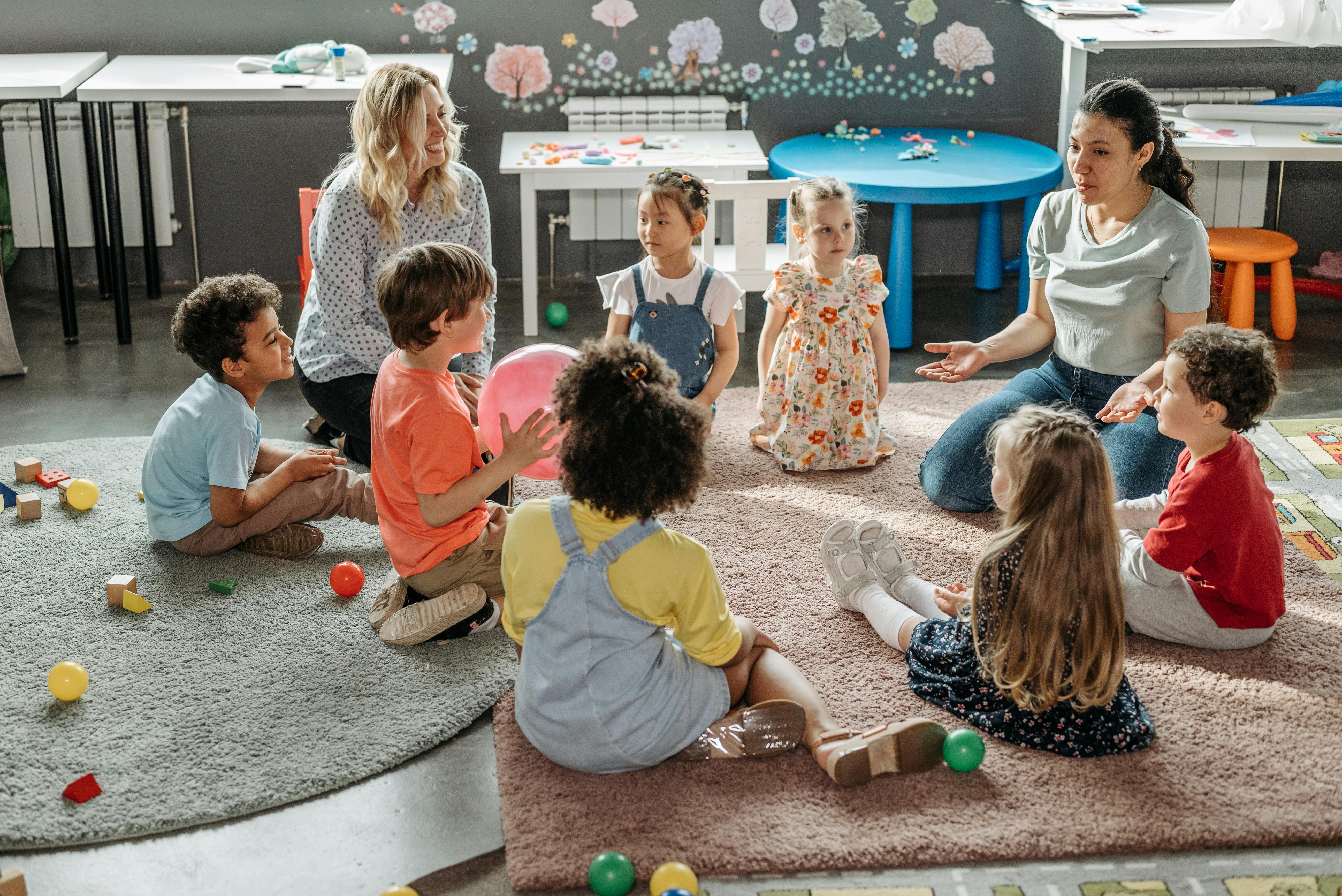
A good preschool visit is not a tour. Request to observe an actual session, not just a walk-through of empty rooms before children arrive. What you see during thirty minutes of real activity tells you more than any amount of marketing material.
What to look for:
Children's engagement. Are most children absorbed in something — building, painting, talking, playing? NAEYC's guidance on great preschools states that children should be spending most of their time actively engaged, not wandering, waiting, or sitting silently. A classroom where children are doing a mix of self-directed and small-group activities, with long stretches to explore, is a good sign.
Teacher interactions. Watch how teachers talk to children. Do they get down to the child's physical level? Do they ask open questions rather than testing-style questions ("what do you think will happen?" versus "what colour is that?")? Do they listen and respond to what children say, or do they redirect quickly to the next activity? The quality of this back-and-forth — what researchers call "serve-and-return" interaction — is the single most important thing you will observe.
Noise and tone. A preschool classroom should be active and somewhat noisy — children talking, moving, playing. That is healthy. What you do not want to hear: raised adult voices, sharp commands, or a general atmosphere of adult management rather than child engagement. A calm but not silent room where adults are mostly talking with rather than at children is the right texture.
The walls. NAEYC lists this as a marker of quality: classrooms should be decorated primarily with children's own work, not with professionally produced posters and identical seasonal crafts where twenty children's output looks identical. Children's original artwork, dictated stories, photos of their play — these signal that children's work is valued and individual.
Outdoor access. Ask how much time children spend outside each day and in what conditions. Settings that keep children indoors except in perfect weather are not meeting the physical activity needs of this age group. Daily outdoor time — in most weather — is a marker of a programme that understands child development.
The bathroom test. Look at the bathroom. Is it clean, accessible, and set up for children to manage as independently as possible? Hygiene and physical care are basic indicators of how the whole setting is run.
Step 4: The Questions That Reveal the Most
In addition to what you observe, ask these directly:
"What is your settling-in process?" A good programme has a structured transition period — typically several weeks — where children gradually increase their time and a parent or carer is involved in early sessions. A setting that says "they adjust quickly, most children are fine by day two" is either very lucky or not paying close enough attention to children who are not fine.
"How do you handle behaviour challenges?" Listen for: co-regulation, redirection, understanding of child development, natural consequences. Be wary of: time-outs as a primary tool for children under 4, isolation, language about "discipline" that sounds more punitive than supportive.
"How will you communicate with us day-to-day?" You want to hear: regular verbal updates at pickup, written daily reports for younger children, an established process for raising concerns, and regular more formal meetings. A programme where the answer is "we post on an app" but has no mechanism for real conversation is a gap worth noting.
"How long have your lead teachers been here?" As above — this is the stability question. Any hesitation or deflection deserves a follow-up.
"What does a typical morning look like, hour by hour?" This tells you the actual structure of the day. A programme with long open-ended play periods, outdoor time, small group activity, and a calm routine is likely to be a good one. A programme with very short activity blocks, a lot of whole-group instruction, and worksheets is not in line with research on what serves this age group.
Step 5: Trust the Visit, Not the Brochure
The single most consistent finding in the early childhood education literature is that programme quality varies enormously within any category — Montessori, Reggio, forest school, traditional — and that a programme's stated philosophy is a far weaker predictor of what children actually experience than what you see when you watch an ordinary morning. A badly implemented Montessori classroom and a well-run traditional programme are not equally good choices, regardless of what the respective philosophies say on paper.
Visit any setting you are seriously considering at least twice, ideally at different times of day, and at least once without an appointment if the setting permits it. The most revealing preschool visits are the unannounced ones.
Worth knowing: It is entirely reasonable to ask a preschool whether you can speak to one or two current parents before making a decision. Settings confident in their quality will not hesitate. Those that resist or redirect you to testimonials on their own website are worth a second thought.
Timing and Waitlists: The Practical Reality
In many cities — particularly in the US and UK — popular preschools have waitlists of six months to a year or more. The practical advice is to begin visiting and applying earlier than feels necessary, typically when your child is around two years old for a September start at three. This does not mean you have to decide at two; it means you start gathering information and getting on lists while keeping your options open.
If you find the right setting but it is not available when you need it, ask directly: what is your actual waitlist position, and what is the realistic likelihood of a place? Many parents stay on multiple lists and make a final decision when an offer comes in.
For a realistic picture of what your child should be able to do before starting, the signs that your child may be ready for preschool covers the developmental markers worth knowing — and the ones that are often overstated.
Choosing a preschool is a process, not a moment of revelation. The right setting is not the one with the nicest logo or the most impressive website. It is the one where, on a Tuesday morning in October, you could walk in and see children genuinely absorbed in their work, and adults talking with them like the children's thinking matters. That is what you are looking for.
🌱 Discover Your Parenting Wellbeing Score
Get your personalised score across 9 dimensions and find articles curated for your stage.
Get My Score →Community comment
Sign in to join the conversation and share your parenting experiences.
Sign in with Google
No comments yet — be the first to share your thoughts! 💛