Kindergarten Readiness: The Skills That Matter Most (and Least)
Self-regulation and the ability to function independently in a group predict kindergarten success far more reliably than knowing letters or counting to 20.
Phase: School-Age · Topic: Schooling Advice · Type: Evergreen · Reading time: ~8 min
About 3.3 million children start kindergarten in the United States each year. By summer, a significant portion of their parents have spent weeks, maybe months, drilling letter names, counting sequences, and color identification — convinced this is what "being ready" looks like. The research on what actually predicts kindergarten success tells a different story, and most parents would feel considerably less anxious if they knew it.
Kindergarten readiness is real and it matters: children who arrive better prepared show higher achievement not just in kindergarten, but through third grade and beyond, according to longitudinal research published by Applied Survey Research. But the skills that drive those outcomes are not the ones that tend to show up on the Pinterest worksheets.
What the research actually identifies as the core skills
The most consistent finding across child development research — from the Office of Head Start's frameworks to a 2024 review in Early Childhood Research Quarterly — is that the constellation of readiness skills matters more than any single one, and that the skills with the highest predictive power cluster around self-regulation and executive function, not academic knowledge.
Self-regulation covers three connected capacities: the ability to manage emotions without adult intervention, the ability to sustain attention on a task, and the ability to hold a rule in mind and follow it even when something more interesting is available. Executive function — working memory, inhibitory control, and cognitive flexibility — is the underlying neurological architecture that supports all of them.
Why do these matter more than letter knowledge? Because a child who can manage their feelings, sit through a group activity, and redirect their own attention when distracted is a child who can learn in a classroom. A child who knows all 26 letters but melts down when their block tower falls, or cannot stay on a carpet square for ten minutes, will spend significant teacher time and emotional energy on regulation rather than instruction. The letters get taught in kindergarten. Self-regulation is the scaffolding on which everything else is built.
The 2024 NIEER (National Institute for Early Education Research) survey found that parents' concerns about children's pro-social skills — sharing, cooperating, making friends — did not recover to pre-pandemic levels after COVID disruptions, and experts identified this as a meaningful gap. Child Mind Institute reports similarly that kindergarten teachers consistently rank emotional maturity and independence above academic pre-knowledge when describing what actually prepares children for the classroom.
What "ready to function in a group" means in practice
This is not abstract. A child who is ready for kindergarten can, in practice:
Follow a two-step instruction the first time — "put your crayons away and come sit on the rug" — without needing reminders. Not perfectly, not always, but reliably enough that a teacher managing 20 children can trust it.
Separate from a parent without a prolonged crisis. This does not mean zero tears on day one — that is developmentally normal and expected. It means the child can establish trust with another adult and engage with the environment within a reasonable window after drop-off. If separation anxiety at drop-off has been a persistent feature of preschool or daycare, working on that transition is more relevant kindergarten preparation than letter flashcards.
Wait their turn and tolerate frustration for short periods. A child who screams when they don't get the red crayon, or cannot wait ninety seconds for a teacher to help them, will find a full-day kindergarten program genuinely difficult regardless of their letter knowledge.
Use words to express basic needs and feelings. "I need help." "I don't understand." "I feel frustrated." Children who can communicate this way require far less behavior management and can participate more fully in instruction.
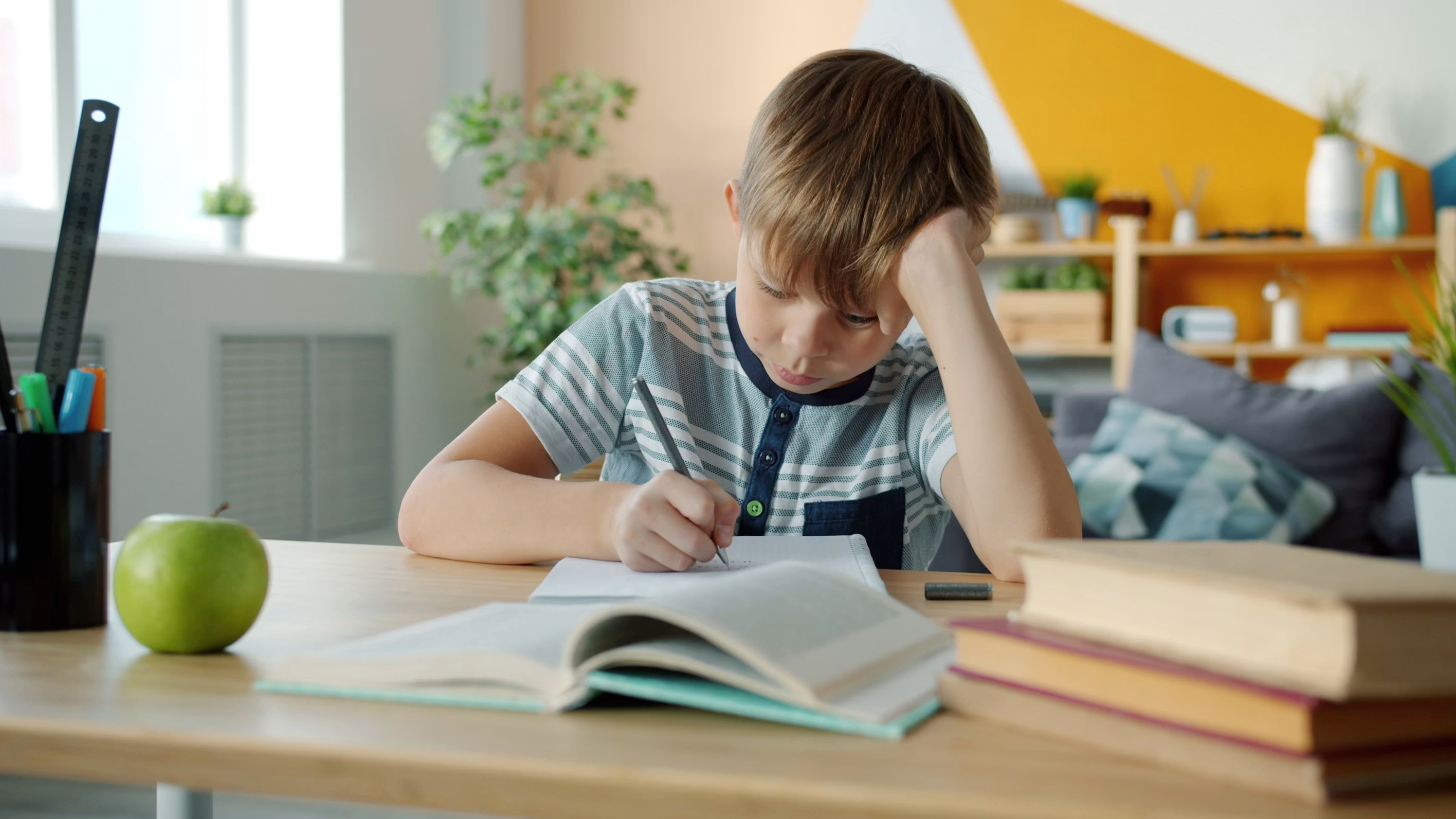
Engage independently for 10–15 minutes. Kindergarten involves independent work time. A child who has never been expected to complete a simple task without constant adult attention will find this transition hard.
None of these require formal instruction. They develop through play, through routines, through being held to reasonable expectations at home, and through the hundreds of small daily moments in which a child practises managing themselves.
The academic skills that actually help — and the ones that don't
This is not a case against early literacy or numeracy. Some academic pre-knowledge is genuinely predictive. The question is which knowledge, and how much.
Useful: Phonological awareness — the ability to hear and manipulate sounds in spoken language. Rhyming, clapping syllables, noticing that "cat" and "hat" end the same way, playing with the first sounds in words. This is the precursor to reading, and it develops through books, songs, nursery rhymes, and word games, not through alphabet drilling. Building a home reading habit develops this naturally and effectively.
Useful: Oral language and vocabulary. A child who has been talked to, read to, and engaged in conversation has a larger vocabulary and stronger comprehension that directly supports reading instruction. The single best predictor of later literacy is vocabulary at school entry, and vocabulary is built through conversation and exposure to books — not worksheets.
Useful: Understanding that numbers represent quantities, and that larger numbers mean more things. One-to-one correspondence (each counted object gets one number). Recognizing a few numerals. Not: counting to 100, or writing numbers.
Overhyped: Knowing all 26 letter names and sounds before kindergarten. Kindergarten explicitly teaches this. Not knowing every letter is not a gap — it is the starting point. Knowing a child's own name in print, recognising a handful of letters, and understanding that text carries meaning is enough. The child who arrives knowing all 52 upper and lower-case letters and their sounds is ahead, but the child who doesn't is not behind. Teachers are trained to meet both.
Overhyped: Writing their full name legibly. Writing their first name — especially in a family with a long or complex name — is nice but not essential. Fine motor development continues well into kindergarten and first grade. What matters more is that a child can hold a pencil comfortably and has experience with mark-making.
Overhyped: Knowing shapes, colors, and numbers to 20 as a prerequisite. These are taught in kindergarten. A child who doesn't know "trapezoid" is not behind. A child who can sort objects by attribute and notices patterns is demonstrating mathematical thinking that transfers well.
Worth knowing: A 2024 Kindred Squared survey of UK primary teachers found that the most commonly cited readiness gaps were not academic — they were physical (children lacking core strength to sit on the floor for carpet time) and communicative (children unable to express needs verbally). Screen time displacing physical play and conversation was named as a primary contributing factor by teachers.
What to actually do before September
If your child starts kindergarten in the next few months, here is where to put your energy:
Build physical stamina and gross motor skills. Kindergarten involves significant time sitting on the floor, walking in lines, carrying a backpack, and navigating a busy environment. Children who have spent large portions of their day sedentary — particularly on screens — sometimes arrive without the core strength to sit comfortably for carpet sessions. Outdoor play, climbing, running, and any unstructured physical activity helps.
Practise independence in daily tasks. Can your child put on and take off their shoes? Manage their own backpack? Open their lunch box independently? Use the bathroom without help and wash their hands? These practical self-care skills directly affect how much a kindergarten teacher's attention is consumed by logistics versus instruction. Practising the lunch box routine before day one removes one anxious variable.
Read together daily. Not to teach letters, but to build vocabulary, comprehension, and the habit of sitting with a narrative. Talking about what's happening in the book — "why do you think she did that?" — builds the inferential thinking that reading comprehension requires. This is more valuable than any letter-recognition app.
Establish and maintain a consistent routine. Children who function within predictable routines — the same wake time, mealtimes, bedtime — adapt to a school schedule far more smoothly. The power of predictable routines on a child's sense of security and self-regulation is well-documented. Starting a school-aligned schedule several weeks before September makes the transition significantly less jarring.
Play with other children regularly. Unstructured play with peers — at a park, a playgroup, a neighbour's yard — is where children practise turn-taking, negotiation, managing conflict, and recovering from social friction. These are the exact skills they'll need to manage a classroom of twenty children they've never met.
When to be genuinely concerned
Most kindergarten anxiety is misplaced — focused on pre-academic gaps that teachers are specifically trained to address. But there are signals worth paying attention to.
If your child, at five, cannot separate from a primary caregiver after a reasonable settling-in period across multiple settings; if they have no functional words to express basic needs; if they struggle significantly with any change in routine; if they cannot sustain attention for even a few minutes during a preferred activity — these are worth a conversation with your paediatrician before the school year starts. None of these necessarily indicate a problem, but they are the kinds of things an early childhood professional can help contextualise.
Signs of a learning difference are also worth knowing, not to diagnose your child in advance, but because early support for children who need it makes a meaningful difference — and kindergarten entry is often when patterns first become visible to more than one adult.
What to tell yourself this summer
Kindergarten teachers spend their professional lives meeting children exactly where they are. They have seen every starting point. The child who arrives knowing nothing about letters will learn to read. The child who cries at drop-off in September typically stabilises within weeks. The child who can't sit still in August learns, with structure and time, how to manage their body in a classroom.
What kindergarten teachers consistently say they cannot easily fix is a child who has no experience managing disappointment, who has never been expected to do anything independently, or who has not been read to and talked to enough to have the vocabulary to access instruction. Those gaps take longer to close, and they're the ones worth attending to before September.
The alphabet will be taught. Self-regulation, language, and the security that comes from a predictable home life — that's what you can give your child this summer that will actually matter.
🌱 Discover Your Parenting Wellbeing Score
Get your personalised score across 9 dimensions and find articles curated for your stage.
Get My Score →Community comment
Sign in to join the conversation and share your parenting experiences.
Sign in with Google
No comments yet — be the first to share your thoughts! 💛