How to Plan a Family Camping Trip When You've Never Camped Before
Start with an amenity-rich campground one to two hours from home, borrow or rent gear before buying, and set up your tent in the backyard first.
Phase: School-Age · Topic: Family Activities · Type: Evergreen · Reading time: ~8 min
A 2024 University of Glasgow study found that children who spend just one hour per day in nature have a 50 percent lower risk of developing mental health problems. Camping delivers that hour in blocks of twelve. It's one of the most efficient things you can do for your children's wellbeing — and according to KOA's annual outdoor hospitality report, more than three-quarters of family campers say it improves their relationships. That's the version your social media feed shows.
What it doesn't show is the first trip where you set the tent up in the dark because you underestimated how fast it gets dark, realised you forgot a can opener, and one child refused to use the campground bathroom. The good news is that all of those things are preventable, and the trip that follows a well-planned first one tends to be significantly better than almost any holiday you'll take.
This guide is for families who want to get it right before they go, not after.
The first decision: what kind of camping are you actually doing?
"Camping" covers more ground than it should. A first-time family camping trip does not mean backcountry wilderness with bear canisters and water filtration. For most families with children aged five to twelve, car camping at a developed campground is the right starting point — and making peace with that is the first thing to get sorted.
A developed campground means you drive to your site, park your car next to it, and pitch your tent on a flat pad twenty metres from a bathroom with running water. Many have hot showers. KOA campgrounds, state park campgrounds, and many national forest sites fall into this category. These are not "cheating" at camping. They are how more than 80 percent of family campers start, according to camping industry research, and they allow you to focus on actually enjoying the experience rather than managing logistics in the dark.
The single most useful rule for a first trip: stay within 90 minutes of home. This sounds deflatingly modest, but it means that if something goes badly wrong — someone gets sick, the weather turns genuinely dangerous, the children mutiny — you can be home in under two hours. The shorter the drive, the lower the stakes, and lower stakes make the trip more relaxed from the start.
For campground selection, the Reserve America or Recreation.gov websites cover the majority of US state and national park campgrounds. In the UK, the Pitchup app has reliable family campground reviews. Filter for: electric hook-up sites (which let you charge devices and run a small fan if it's hot), flush toilets, and — if at all possible — a site with playground equipment on-site or within walking distance. Family campers who choose amenity-rich campgrounds report 80 percent satisfaction rates, according to KOA research. The playgrounds keep younger children occupied in the hour before and after meals, which is when things most commonly unravel.
Gear: the minimal version that actually works
Camping gear advice is where sensible planning most easily spirals into a $2,000 shopping spree. The list below is what you actually need for a two-night first trip. Borrow or rent anything you can before buying — REI, for example, rents tents and sleeping bags, and many outdoor retailers now offer gear rental. Your first trip will teach you what matters to your family specifically; buying everything before you know that is how you end up with a $400 sleeping pad you never use.
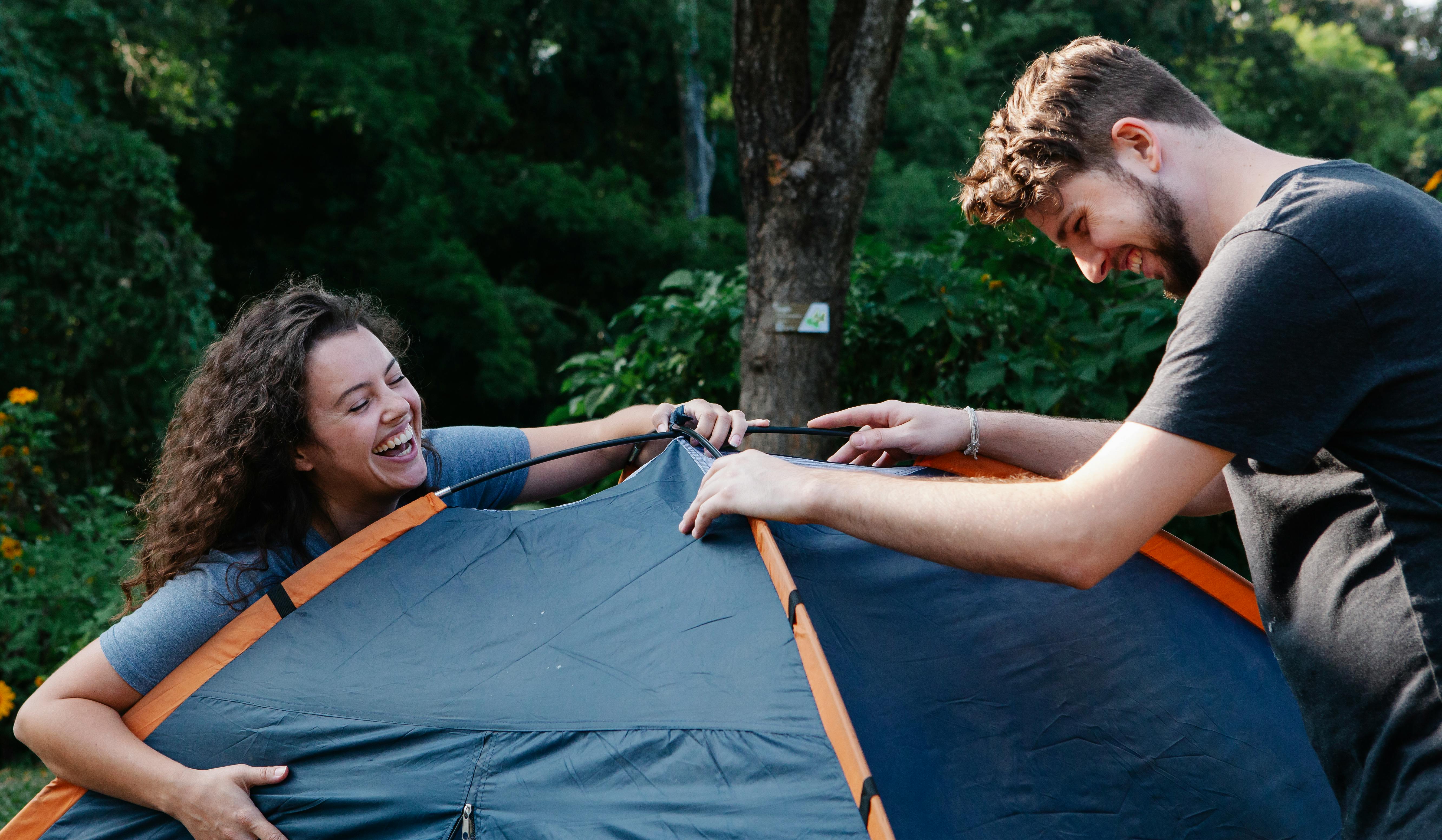
Tent: A four-person tent for a family of four is too small; the floor area fills up with gear. For a family of four, a six-person tent gives you actual space. The REI Co-op Skyward 6 (~$350) and the Coleman Skydome 6 (~$100) are both well-reviewed entry options. The Coleman is fine for calm weather; the REI holds up better in rain and wind. Whichever you choose: set it up in your garden before you leave. This is not optional. Almost every first-trip disaster story begins with attempting to erect an unfamiliar tent after a three-hour drive with hungry children.
Sleeping bags: Sleeping bags are rated by the lowest temperature at which they'll keep an adult alive — not comfortably warm. For summer camping, a bag rated to 10°C (50°F) works in most temperate conditions. Children sleep cold; bag one size warmer than the forecast temperature. The Teton Sports Mammoth is a functional family-priced option; for children, the Coleman Kids 10°F bag is widely available and genuinely usable.
Sleeping pads: Sleeping on bare tent fabric on the ground is cold and uncomfortable regardless of your sleeping bag. A self-inflating foam pad (the Therm-a-Rest Trail Scout, around $50, is the entry point) makes the difference between sleeping and not sleeping. Air mattresses are bulkier but more comfortable; for car camping the added bulk doesn't matter.
Cooking: A two-burner propane camp stove (the Coleman Classic two-burner, around $55, has been essentially unchanged since 1976 and works) and a set of camp cookware. For a first trip, plan meals that require minimal cooking: scrambled eggs and toast, pasta with jarred sauce, foil-packet meals cooked over the fire. The Coleman Classic uses the green 1lb propane canisters available at almost any petrol station or supermarket along the route.
Light: One headlamp per person. This is the single most important item that beginner campers forget or underestimate. Children especially need their own — the moment it gets dark and a child needs to walk to the bathroom in the dark with no torch is the moment the trip turns bad. Petzl and Black Diamond both make reliable children's headlamps under $25.
The overlooked items: A full roll of kitchen paper, a packet of wet wipes, a small cutting board, a bottle opener and can opener, a lighter and a backup lighter, a small rubbish bag, and biodegradable camp soap. These are consistently what experienced campers cite as the things beginners forget.
Worth knowing: A 2024 scoping review of 40 outdoor adventure education studies in Frontiers in Psychology found that across all studies, outdoor nature experiences were associated with enhanced resilience, reduced anxiety, and stronger peer relationships in children. These benefits held across age groups and activity types — from structured adventure programmes to informal camping trips.
The first night: managing expectations honestly
The first night is almost always the hardest. This is not a failure; it's a known property of camping with children. Here's what to prepare for:
Children sleep worse than usual on the first night. The sounds are different, the light is different, the ground is different. Bring a comfort item — a favourite stuffed animal or their own pillow from home — for each child. Don't make a big deal of it; just pack it. Children aged five to eight are particularly sensitive to this, and having something familiar often closes the gap between anxious-awake and asleep.
It gets cold faster than you expect after dark. Even a summer night at altitude or in a forest can drop fifteen degrees between sunset and midnight. Have children in long trousers and a fleece before the sun goes down, not after they start shivering.
Build in dead time. The gap between finishing dinner and actually sleeping is where most first-trip meltdowns happen. Plan something for that window: a campfire (even a small one), stargazing on a blanket, card games by headlamp. Uno, Dobble, and a pack of regular playing cards all weigh nothing and work in the dark with headlamps.
The campground bathroom is often fine. For children who are nervous about outdoor toilets, a reconnoitre walk before dark — going together, seeing that it's just a normal bathroom, using it once while it's still light — usually dissolves the anxiety. Save the conversation about pit toilets for trip three.
Keeping children engaged at camp
The most underestimated challenge of camping with children is not the logistics — it's the two hours before and after activities when children at home would default to screens. A campsite has no screens. The gap needs filling.
Give children camp jobs. Collecting firewood within the campsite boundary, carrying water from the spigot, setting the table (a cloth or mat on the picnic table), washing up, gathering gear. Children aged six and up handle this well and it channels the "nothing to do" energy into something purposeful. It's also genuinely useful for the building responsibility in children angle — chores at camp feel different from chores at home because there's a real, immediate consequence to not doing them.
Bring a nature scavenger hunt. Print one before you go, or write it on a piece of paper. For ages five to eight, fifteen items is enough: find a leaf with five points, something that smells interesting, a piece of bark, something left by an animal. Children who have a list are occupied; children with nothing to do will find their own entertainment, which at a campsite usually means destabilising something.
Hike with a specific destination. "Let's go for a walk" lands badly with most children over age six. "Let's hike to the waterfall" or "let's find the lake on the map" works completely differently. AllTrails has a free tier, and filtering for trails under 5km with good reviews from families takes about three minutes. Download the map offline before you leave the car, since mobile signal at campgrounds varies widely.
What to expect on the drive home
The drive home from a first camping trip tends to be one of two things: entirely silent because everyone is exhausted and satisfied, or a loud recap of everything that happened. Either is a good outcome.
Before you pack out, take five minutes to let children take photos of the campsite, the firepit, the view. The act of documenting it tells them — and you — that it was worth recording. Research on outdoor childhood experiences published in Environmental Health Perspectives found that children who camp during early school years are more likely to seek out nature voluntarily as adults. You are planting something on this trip that lasts much longer than the weekend.
The second trip is easier. The third trip is comfortable. By the fourth, it's something your family does.
For families planning longer or more ambitious outdoor adventures from here, the road trip guide for families covers the logistics of multi-day car travel with children — much of the same packing philosophy applies, with an entirely different set of things that go wrong.
🌱 Discover Your Parenting Wellbeing Score
Get your personalised score across 9 dimensions and find articles curated for your stage.
Get My Score →Community comment
Sign in to join the conversation and share your parenting experiences.
Sign in with Google
No comments yet — be the first to share your thoughts! 💛