Raising Outdoorsy Kids: How to Make Nature Part of Your Family Culture
Raising outdoorsy kids is about frequency and attitude more than adventure scale — small, regular outdoor time outperforms occasional epic trips.
Phase: Family · Topic: Family Activities · Type: Evergreen · Reading time: ~7 min
The average American child between the ages of six and seventeen spends just seven minutes a day in unstructured outdoor play — a figure from the University of Michigan that represents roughly a 50 percent decline from the previous generation. That drop has happened quietly, in the gap between school, screens, organised activities, and the indoor pull of modern home life. Most parents haven't made a deliberate choice to keep their children inside. It has simply accumulated.
What's accumulated alongside it is a significant body of evidence about what that time loss costs. A 2024 University of Glasgow study found that children who spent just one hour a day in nature had a 50 percent lower risk of mental health difficulties than those who did not. A study published in JAMA Network Open the same year found that a three-month nature-based school intervention reduced anxiety, depression, and impulsivity in children — with the strongest improvements in children who had started with the most significant difficulties. The findings aren't marginal. They're the kind of effect size that would justify a pharmaceutical trial.
None of which answers the practical question: how do you actually build a family that spends time in nature, especially if you didn't grow up that way?
The Outdoorsy Parent Myth That's Stopping You
The image that most families carry of an "outdoorsy" family involves mountain trails, REI membership, and children who cheerfully eat trail mix. It's an intimidating picture if your current relationship with the outdoors is a walk around the block twice a week. The good news: the research doesn't make that distinction.
Studies on children's nature time consistently find that benefit comes from regular exposure to green space — including city parks, schoolyards with trees, gardens, and neighbourhood streets with decent canopy cover. A child who spends an hour in a local park three times a week is accumulating substantially more protective nature time than a child who goes on one impressive camping trip a year. Frequency and consistency matter more than impressiveness. The park you can walk to beats the national forest you plan to visit someday.
This also means the entry point for becoming a more outdoorsy family is almost always smaller than families assume. It is not a camping trip. It is not a hike with a destination. It is an hour outside, in the same place, with low expectations, done regularly enough that it becomes a habit rather than an event.
What Children Actually Need (Not What They Say They Want)
Children resist going outside for the same reason they resist most things that are good for them: they're comfortable where they are, and the alternative requires effort. This is not a sign that outdoor time isn't working. It's just friction.
The most effective approach documented in parenting research is removing that friction rather than battling it. For younger children, this means going outside before they've had the chance to settle into screens — the first half-hour after school or on weekend mornings, before the alternative anchors them. For older children, it means finding the specific outdoor thing they care about and starting there: not a hike, but a trail with a creek they can dam; not "nature," but the local skate park or basketball court that happens to be outside.
Children who participated in planning outdoor activities — choosing where to go, what to bring, which route to take — were substantially more likely to engage once they got there, according to CBC's parenting coverage of outdoor research in Canada. The planning gives them ownership. A child who picked the destination is considerably less likely to complain that they're bored on arrival.
One of the easiest ways to build this into a regular structure is to anchor outdoor time to an existing family routine. A Saturday morning walk before breakfast, a post-dinner park visit on weekdays, a weekly nature spot that becomes yours. Family routines create the predictability that makes any behaviour feel normal — outdoor time is no different. Once it becomes the expected thing rather than a special production, children stop resisting it as a departure from normal.
Start Smaller Than You Think Is Worthwhile
One of the most durable pieces of outdoor parenting wisdom — and one of the most counterintuitive — is knowing when to turn back. A hike that ends at the halfway point with everyone in a decent mood will be remembered more warmly than one that reaches the summit with two crying children and a parent who is done. The first creates appetite. The second can set the outdoor habit back by weeks.
This applies to the scope of ambition from the start. A family that begins with a 20-minute walk around a local pond and calls it a success has done more than a family that attempted a full-day trail and swore off hiking afterwards. Small wins compound. The child who enjoyed the pond walk asks to go back. The child who suffered through an overambitious trail does not.
Researcher and outdoor writer Jo Piazza, who began as a self-described "very indoorsy person," identified a practical rule for parents raising outdoor-oriented children: don't complain about the weather yourself. Children model adult attitudes to discomfort closely. A parent who treats rain as a problem produces children who treat rain as a problem. A parent who grabs a waterproof layer and treats it as normal produces something different. This isn't about forced enthusiasm — it's about not loading the experience with adult anxiety before it's begun.
Worth knowing: The range within which children are allowed to roam independently has declined by around 90% since the 1970s, according to studies cited by outdoor education researchers. Some of the barrier to outdoor time is parental anxiety about safety, not just child resistance. Familiar, local green spaces — the park around the corner, the garden, the school field — are a useful middle ground that gradually expands children's comfort with unstructured outdoor time.
Gear: What You Actually Need vs. What Gets Marketed
The outdoor industry has a powerful commercial interest in making families feel they need specialist equipment before they can go outside. They do not. Children can hike, explore, and spend extended time outdoors in regular trainers, regular clothes, and with a water bottle and a snack. That said, two investments pay off meaningfully in terms of how comfortable and willing children are outdoors:
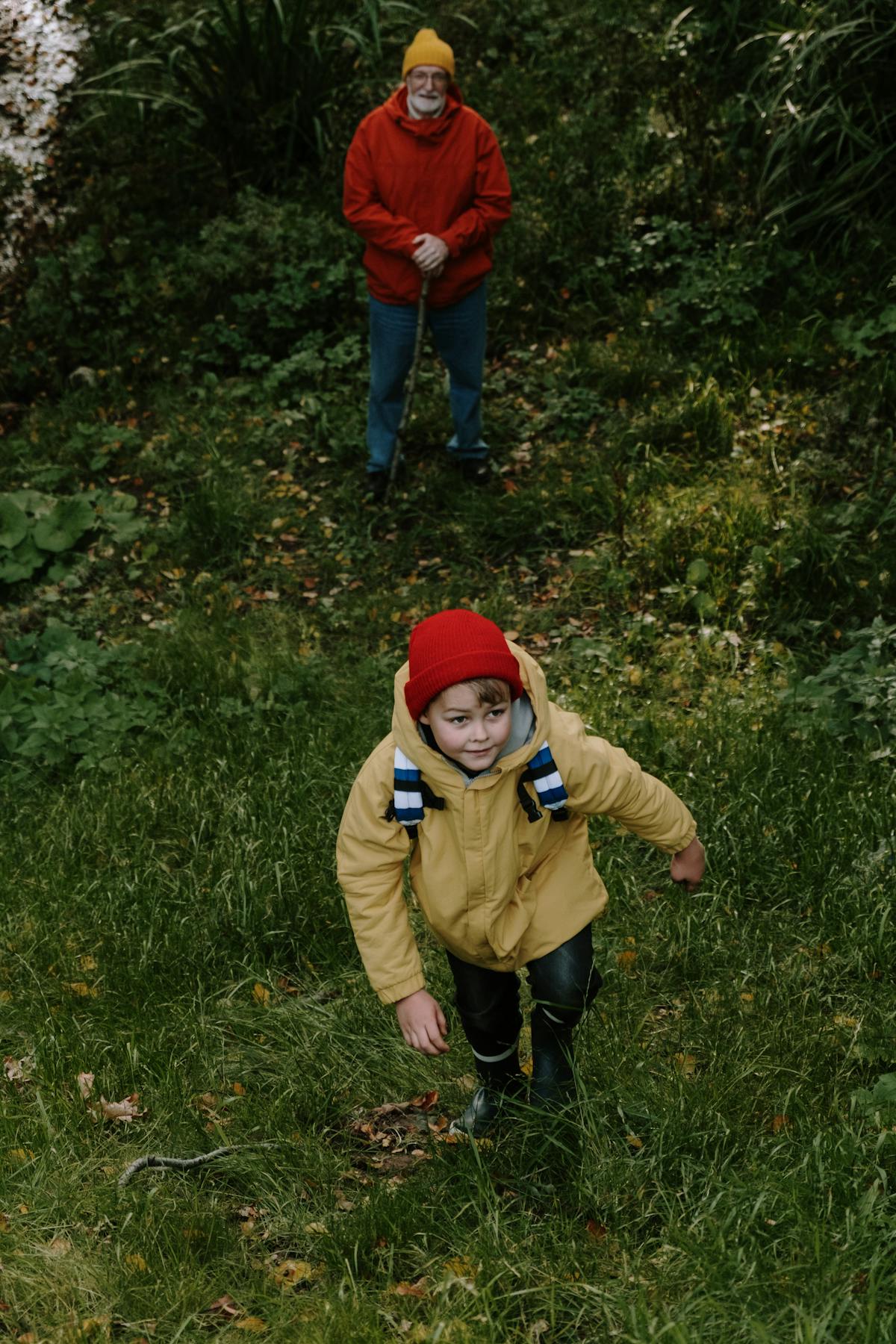
Waterproof layers. A child who gets cold and wet and has no remedy will refuse to go outdoors again for a week. A Regatta or Columbia waterproof jacket at any price point makes wet weather a non-issue rather than a trip-ender. This is the single most impactful gear item for sustainable outdoor habits in cooler climates.
A decent backpack that is their own. Giving a child their own small backpack — with snacks they chose, a magnifying glass, a small notebook — transforms outdoor time from "going for a walk" into "an expedition." It's a relatively small investment for a significant attitude shift, particularly in the 5–10 age range.
Beyond those two, most outdoor gear for families is a nice-to-have rather than a prerequisite. Start outside, figure out what's actually making it harder, then buy the specific thing that fixes that problem. Don't pre-equip for problems you haven't had yet.
For families ready to step up to overnight adventures, the beginner's guide to family camping covers exactly what gear matters and what doesn't for a first trip. And for summer specifically, the summer bucket list for families with kids ages 5–12 offers a concrete activity menu that mixes ambitious and easy entries in equal measure.
Making It Stick: Nature as Culture, Not Occasion
The difference between a family that occasionally does outdoor things and a family that has genuinely made nature part of its culture is repetition and normalisation. Occasional outdoor trips feel like events. Regular outdoor time feels like what your family does.
Three things accelerate this shift:
Name your places. A specific local spot that belongs to your family — your pond, your trail, your park bench with the good view — builds accumulated meaning that a different destination each time cannot. Children who have a place develop attachment to it. That attachment becomes motivation.
Notice things together, specifically. "Look at the clouds" does less than "there's a red kite — same one we saw last Tuesday." Apps like Merlin Bird ID (free, from Cornell Lab of Ornithology) and iNaturalist turn outdoor time into low-stakes wildlife identification without requiring any parental expertise. Children who learn to notice nature pay more attention to it. Attention sustains engagement.
Connect it to their interests. A child who is obsessed with dinosaurs finds fossils compelling. A child who loves art finds fungi and leaf patterns interesting. A child who is competitive finds trails with natural features to climb or cross first. Nature doesn't have to be presented as a category — it can be the setting where other interests play out.
The mental health case for regular outdoor time is strong enough that it belongs alongside sleep and nutrition as a basic health habit for children. A 2024 JAMA Network Open study found teachers described children who had had regular outdoor nature time as more calm, relaxed, and attentive in class. Those are the same outcomes parents are hoping for from a calmer home environment — and the strategies for building that calm at home and outdoor time are more complementary than they might initially seem.
The Long View: What You're Actually Building
Childhood outdoor experiences are a strong predictor of adult nature engagement. Research published in AJPM Focus in 2024 found that frequent outdoor experiences in childhood were among the most consistent factors in predicting how much time adults spent in nature later in life. The child who has a local pond, a weatherproof jacket, and a parent who doesn't treat rain as catastrophic is more likely to become an adult who goes for runs in autumn and takes their own children to the park on Sunday mornings.
That compounding effect is the real argument for making this a priority now, not when the children are older or when the family is more organised. The best outdoor habit is the one that starts this week, at the nearest patch of green, in ordinary clothes, with no particular destination.
🌱 Discover Your Parenting Wellbeing Score
Get your personalised score across 9 dimensions and find articles curated for your stage.
Get My Score →Community comment
Sign in to join the conversation and share your parenting experiences.
Sign in with Google
No comments yet — be the first to share your thoughts! 💛