Road Trip With Kids: The Sanity-Saving Packing List and Game Plan
Leave at 4–5am, give each child their own activity bag, plan stops every 2–3 hours, and treat the drive as part of the trip rather than an obstacle to it.
Phase: School-Age · Topic: Family Activities · Type: Evergreen · Reading time: ~8 min
The best road trips with children work not because the children were perfectly behaved but because the adults were well-prepared. The version that ends in "we should never do this again" and the version that ends in "let's find somewhere further next time" are separated by a handful of decisions made before you ever leave the driveway.
For children aged five to twelve — old enough to be genuinely curious about the world outside the window, young enough that seven hours in a car is still a test of everyone's patience — this is the planning framework and packing list that makes the difference.
The single most important decision: when to leave
Most road trip advice buries this, but departure time is the biggest lever you have over how the trip goes.
Leaving at 4 or 5am sounds brutal. It is, briefly. But school-age children will sleep for the first two to three hours of a 4am departure, which means you cover significant distance before anyone is hungry, bored, or asking if you're nearly there. You arrive at your destination with the whole day still ahead of you, traffic is minimal, and you've spent the hardest part of the drive in relative quiet.
Leaving at bedtime (7–8pm) works well if you have two adults who can share the driving — one sleeps while the other drives, kids sleep through most of it. It does not work safely with a single driver who will hit fatigue around midnight with sleeping children in the back.
Leaving at 9am, when everyone is well-rested and cheerful, sounds sensible but puts you in peak traffic and ensures children are fully awake and impatient for the entire journey. For trips over three hours, avoid it.
A practical benchmark from road trip planning research: children aged six to ten can manage five to six hours of total driving per day with stops every ninety minutes to two hours. Push past that and behaviour deteriorates rapidly, not because children are difficult but because sitting still in a confined space is genuinely hard.
Packing: the two categories that matter
Road trip packing has two completely separate problems. The first is logistics — what you need to function. The second is in-car management — what you need to keep children occupied and the drive tolerable. Most packing lists conflate these, which is why they run to one hundred items.
The logistics bag (in the boot / trunk, accessed at stops)
Pack these in a single accessible bag or box, not buried under luggage:
First aid kit — not a token travel one, a proper one. Include children's paracetamol/acetaminophen, antihistamine for allergies, plasters, antiseptic wipes, and motion sickness medication. Children aged two to twelve are the demographic most affected by car sickness, according to the AAP, and the medication works best when given before symptoms begin, not after.
A change of clothes per child, in a zip-lock bag, accessible without unpacking the entire boot. This earns its place on every trip.
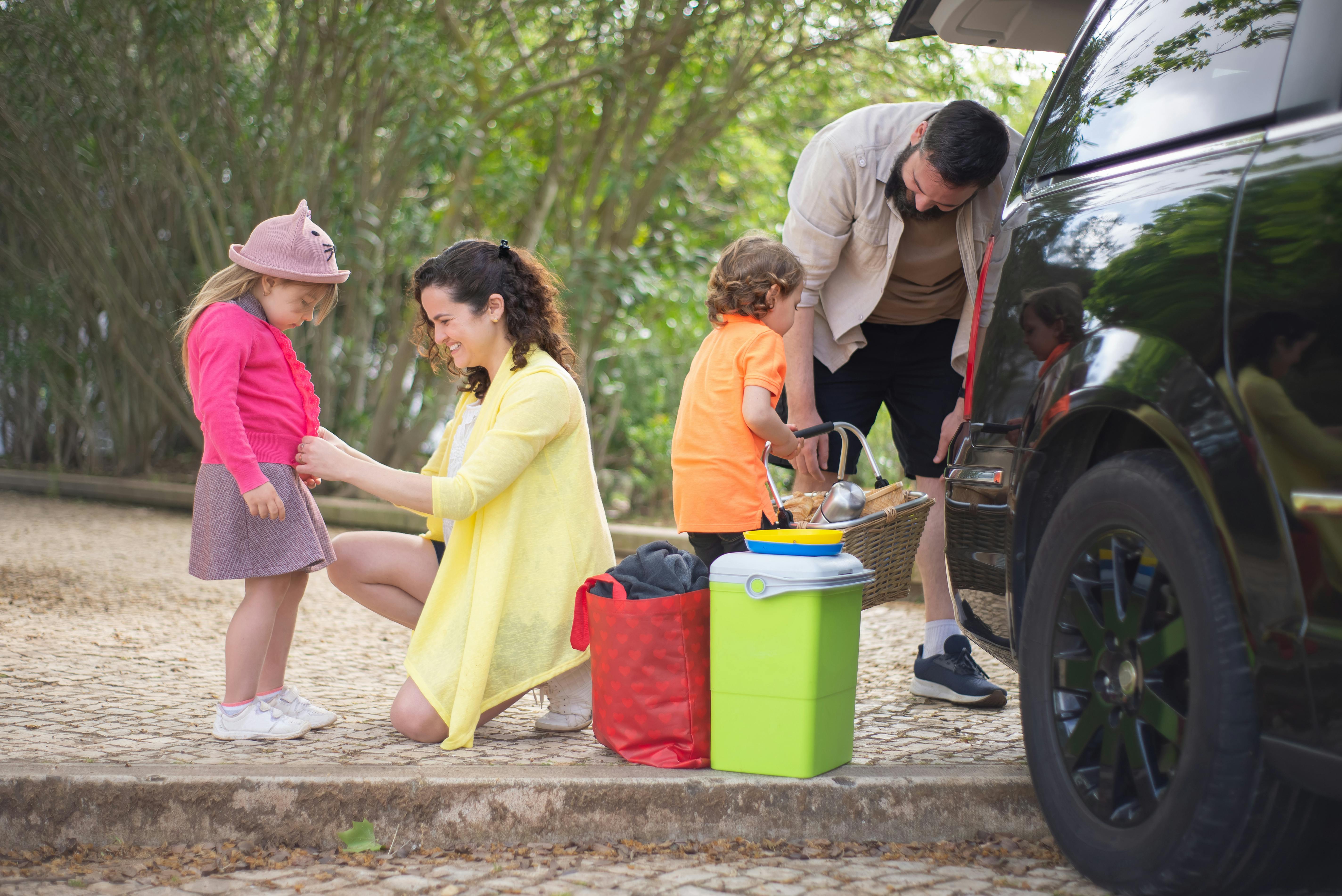
Snacks — the road trip snack philosophy that works: avoid strong smells (which can trigger nausea), avoid anything requiring two hands to eat (for the driver), prefer items that take time to eat over items that are finished in thirty seconds. Grapes, apple slices, crackers, string cheese, trail mix, and a treat saved for the second half of the journey. A small cooler bag keeps things fresh and doubles as a snack station at stops.
Wipes, hand sanitiser, a roll of kitchen paper, and a small rubbish bag that clips to something in the front.
A portable phone charger and the relevant cables. At least one per device you'll be relying on for navigation or entertainment.
A physical map or offline maps downloaded before you leave. Mobile signal on motorways is reliable; on smaller roads approaching interesting destinations it is not.
The in-car bag (each child's own, within reach of their seat)
This is the element most road trip guides undervalue. Each child aged five and up should have their own small bag or drawstring sack within reach of their seat, packed with items chosen partly by them. Ownership of the bag changes how they use it.
For ages five to eight, this bag typically contains: a small notebook and a few pens or crayons (Twistable crayons are better than standard ones in a car — they don't break and don't roll away), two or three small physical books or activity books, one or two small toys (nothing with multiple tiny pieces), a headlamp if camping is involved, and one comfort item.
For ages nine to twelve, the bag typically evolves into: a Kindle or loaded tablet for reading and downloading, wired headphones (volume-limiting kids' headphones like LilGadgets or Puro Sound are worth the spend for anything over two hours), a notebook, a card game or travel game (Top Trumps is excellent for this age — no board, no setup, two hands of cards), and their own water bottle.
Critically: tablets and screens are for individual use with headphones, not for whole-car viewing of the same content. Shared screen time in a car means one child always has a bad angle and one adult is distracted by what's playing.
The audiobook: the most underrated road trip tool
A single shared audiobook playing through the car speakers is the most effective way to create a collective experience that keeps everyone in a good mood simultaneously. It occupies adults and children at the same level, requires no screen, and naturally causes conversation at stops ("what do you think happens next?").
For children aged five to eight: The BFG by Roald Dahl (6 hours, read by David Walliams), Charlotte's Web (3.5 hours), or the Flat Stanley series. For ages nine to twelve: Roald Dahl Short Stories (read by the author), Percy Jackson and the Lightning Thief (10 hours — good for a two-day drive), or Harry Potter and the Philosopher's Stone (8 hours). The Libby app connects to most public library cards and allows free audiobook downloads — worth setting up before the trip.
Podcasts work similarly for older children: Wow in the World (science, ages 5–12), Brains On! (science, ages 6–12), and Six Minutes (mystery serial, ages 8+) are all engrossing enough to create genuine shared listening.
Verbal games that don't require equipment
A set of spoken games is worth having in reserve for when tablets need charging, children are bored of their bags, and the audiobook needs a break. These three work reliably across the five-to-twelve age range:
The alphabet game. Everyone in the car tries to find letters A through Z on road signs, in order. One letter at a time, first to spot it calls it. Works for forty-five minutes on most routes before the letter Q becomes a problem.
20 Questions. One person thinks of an animal, object, or place. Everyone else asks yes/no questions. Children aged eight and up can sustain this without adult scaffolding; younger children benefit from a parent playing alongside.
The story chain. One person says a sentence to start a story. Each person adds the next sentence in turn. The only rule is that the story must continue from exactly where the previous person left it. Becomes funnier and more chaotic as it goes on, which is the point.
Motion sickness: what actually helps
Motion sickness is worth preparing for even if no one in your family has experienced it before, since it's most common in children aged two to twelve and frequently appears without warning.
The mechanism, per the AAP: the inner ear senses motion the eyes don't register — particularly when a child is looking at a screen or a book while the car is moving. The window seat at eye level with the horizon is the most protective position.
What works, before symptoms begin: a light snack an hour before departure (not on an empty stomach, not on a full one), a window seat with a view forward, and screens used only when the car is stationary. If a particular child has previously had car sickness, Dimenhydrinate (Dramamine for Kids, approved for ages two and up) given thirty to sixty minutes before departure is consistently effective — but check with your doctor first if your child takes other medications.
What works once symptoms start: pull over, let the child get out and stand on solid ground, cool cloth on the forehead, eyes closed. Do not try to push through. A ten-minute stop costs nothing compared to a car that smells of vomit for the remaining four hours.
Worth knowing: Sea-Bands (acupressure wrist bands) have reasonable evidence for mild motion sickness prevention and are non-medicinal — useful for children who can't take antihistamines or for whom you want to avoid medication on a short trip.
Stops: the philosophy that keeps everyone sane
Plan stops proactively, not reactively. On a six-hour drive, identify three potential stops before you leave: a playground or park at the two-hour mark, a lunch spot or picnic point at the four-hour mark, and one buffer option in between if needed. Knowing where you're stopping removes the negotiation about when, which is where most road trip arguments actually happen.
The best stops are ones that let children move their bodies briefly and intensely — a five-minute sprint across a rest-stop grass area, fifteen minutes on a playground, a quick walk around a viewpoint. Not a sit-down meal at a restaurant, which takes forty-five minutes and re-seats everyone in the same position they've been in all morning. Save sit-down meals for the destination.
For the road trip driving and logistics side of a bigger journey — particularly if it connects to overnight travel — the family camping trip guide covers the stop and activity framework for overnight adventures that often follow a long drive. And if the trip includes multiple days of driving, the summer bucket list has ideas for filling the destination days once you arrive.
The packing list in brief
In the boot, accessible at stops: First aid kit with motion sickness medication, one change of clothes per child in a zip-lock bag, cooler bag with snacks (grapes, crackers, string cheese, trail mix, one treat), wet wipes and kitchen paper, small rubbish bag, portable phone charger and cables, offline maps downloaded.
Each child's in-car bag: Notebook and age-appropriate pens or crayons, two or three books or activity books, one small toy or card game (Top Trumps), headphones, water bottle, one comfort item.
Shared in the car: Loaded audiobook or podcast playlist, car charger for devices, sunglasses for all windows getting direct sun (a cheap clip-on for side windows prevents the particular misery of a sun-blasted child who can't adjust the window).
What the trip is actually for
The drive is not the thing you survive to get to the trip. For children, the hours in a car — the audiobook everyone is following, the verbal games, the "look at that" moments through the window, the shared snacks — are part of the trip. The memories formed in transit are as real as the ones at the destination.
That reframe is the final tool. A trip that leaves at 4am, stops at a random playground at 6am because the children have woken up and need to run, eats supermarket sandwiches by a river at noon, and arrives somewhere new by mid-afternoon has already been an adventure before anything at the destination has happened.
🌱 Discover Your Parenting Wellbeing Score
Get your personalised score across 9 dimensions and find articles curated for your stage.
Get My Score →Community comment
Sign in to join the conversation and share your parenting experiences.
Sign in with Google
No comments yet — be the first to share your thoughts! 💛