Starting Solid Foods: A Pediatrician-Backed Guide for Beginners
Start solids around 6 months when developmental signs are present, prioritize iron-rich foods, and introduce allergens early rather than avoiding them.
Phase: Infant · Topic: Parenting · Type: Evergreen · Reading time: ~8 min
Around five months, most parents start getting the question: when are you starting solids? Sometimes from their pediatrician, sometimes from a well-meaning relative who is convinced that adding rice cereal to the bottle will help the baby sleep. Both conversations can generate a lot of anxiety. The field has changed substantially in the past decade, and some of the most confidently-stated advice — on rice cereal, on allergens, on how to introduce foods — has been reversed by research. Here's where the current evidence actually lands.
When to Start: The Developmental Signs That Actually Matter
The American Academy of Pediatrics and the World Health Organization both recommend introducing solid foods at around six months of age. The critical word is around — the right moment is defined by developmental readiness, not by a birthday.
The readiness signs to watch for are specific:
Head and trunk control. Your baby should be able to sit with minimal support — propped slightly with a rolled towel in the highchair is fine, but flopping forward or sideways means they're not ready. They need the postural stability to safely manage food in their mouth.
The tongue-thrust reflex has faded. Newborns and young infants automatically push things out of their mouths with their tongue — this protects them from choking before they can swallow solids. When you offer a spoon and the food dribbles right back out, the reflex is still present. When the baby can actually move the food backward to swallow, that's the sign.
Interest in food. The baby watches you eat, reaches toward your plate, opens their mouth when food approaches. This isn't just cute — it's a genuine indicator of oral readiness and digestive preparedness.
Most babies hit all three signs somewhere between five and seven months. Some are genuinely ready just past five months; others need until closer to seven. The mistake to avoid is using a single criterion (just the age, or just the interest in food) when all three should be present. If a baby is showing strong interest but can't sit with control, wait.
One important myth to address: starting solids early does not help babies sleep longer. Multiple studies have tested this, and there is no evidence that introducing food before six months improves nighttime sleep. Early introduction does increase the risk of choking, exposure to allergens before the gut is ready, and nutritional displacement of breast milk or formula, which remain the primary nutrition source through the first year.
What to Feed First — And What the Old Advice Got Wrong
Iron-rich foods should be a priority from the beginning. Babies are born with iron stores from their time in the womb, but those stores deplete by around six months. Breast milk is relatively low in iron; formula is fortified. Either way, by six months, iron from food matters. The AAP's guidance is clear: prioritize iron-rich foods as first foods, including iron-fortified oatmeal or multi-grain cereals, pureed meats (beef, chicken, lamb), lentils, and beans.
Rice cereal is no longer the default first food. For decades, rice cereal was the standard recommendation for first foods. It's now understood to be a poor choice for several reasons. Rice absorbs arsenic from groundwater and soil at much higher rates than other crops — up to ten times more than other grains. Consumer Reports testing, FDA analyses, and multiple congressional investigations have all flagged elevated inorganic arsenic levels in infant rice cereal. Inorganic arsenic is toxic and carcinogenic; cumulative exposure in infancy is linked to cognitive problems, lower IQ, and increased cancer risk. The AAP's HealthyChildren.org guidance now states explicitly that rice cereal does not need to be a first food, and recommends oatmeal and other grain-based cereals as safer alternatives. If your baby is already eating rice cereal with no issues, there's no cause for alarm — but there's also no reason to continue defaulting to it.
There's no required order for introducing foods. The old model of vegetables before fruit (so babies don't develop a preference for sweet) or proteins last has no evidence behind it. The AAP says for most babies, you don't need to give foods in a specific order. Offer a variety — pureed vegetables, fruits, iron-rich proteins, grains — in whatever combination works for your family and your baby's acceptance. Variety early is good. Babies who try a wider range of flavors in the first year of eating are more likely to accept those foods as toddlers.
Breast milk or formula stays the primary nutrition source until twelve months. Solids at six months are complementary, not replacement. Through the first year, most of your baby's calories and nutrition should still come from breast milk or formula. Start with one to two small meals per day — one or two tablespoons — and expand from there as the baby shows interest and tolerance.
The Allergen Advice Has Completely Changed
Perhaps no area of infant feeding has shifted more dramatically than allergen introduction. For years, parents were told to delay high-allergen foods — peanuts, eggs, dairy, fish, wheat — to reduce allergy risk. That guidance was reversed after a landmark 2015 clinical trial called LEAP (Learning Early About Peanut Allergy).
The LEAP study found that infants with severe eczema or egg allergy who were introduced to peanut products early (between four and eleven months) and fed them regularly experienced an 81% relative reduction in peanut allergy by age five. A 2024 follow-up confirmed the protective effect was sustained into adolescence: only 4.4% of early introducers had a peanut allergy at age twelve, compared with 15.4% of those who had avoided peanuts. Children's Hospital of Philadelphia published data in late 2025 showing that food allergy diagnoses have measurably declined since these guidelines were implemented.
The current guidance from NIAID, the AAP, and most major allergy organizations:
For babies without severe eczema or egg allergy: introduce peanut-containing foods around six months at home, alongside other foods. There's no need to test beforehand.
For babies with mild to moderate eczema: introduce peanut around six months, at home or in a pediatrician's office depending on preference. Ask your pediatrician if you're uncertain.
For babies with severe eczema or existing egg allergy: consult your pediatrician or allergist before introducing peanut. These babies may benefit from skin testing first.
Practical form: peanut butter blended thin into puree, a small amount of smooth peanut butter on the tip of a spoon, or peanut-containing baby food products. Never give whole peanuts or large clumps — they're a choking hazard regardless of allergy status.
The same early-introduction logic applies to eggs, fish, sesame, wheat, and tree nuts. Introduce them one at a time, a few days apart, so you can identify any reaction. Signs of an allergic reaction typically appear within two hours: hives, swelling around the mouth, vomiting, difficulty breathing. Mild reactions (a small rash around the mouth) are worth noting and discussing with your pediatrician, but are not necessarily a signal to stop. Significant reactions need medical attention.
Worth knowing: It can take ten to fifteen exposures before a baby accepts a new food. Neophobia — wariness of unfamiliar food — is developmentally normal, not a sign of pickiness or rejection. Keep offering the food without pressure.
Foods to Avoid Entirely in the First Year
A handful of foods are firmly off the list before twelve months, with clear clinical reasons:
Honey — all forms, including honey in baked goods — cannot be given to babies under twelve months. Honey can carry Clostridium botulinum spores, which produce a toxin that causes infant botulism. Adult digestive systems neutralize these spores; infant gut flora does not. Infant botulism can cause muscle paralysis and respiratory failure. This is not an abundance-of-caution restriction — it is a hard safety line.
Cow's milk as a drink (not as an ingredient in food or yogurt) should not replace breast milk or formula before twelve months. Cow's milk has too much protein and sodium and too little iron for a baby's kidneys and nutritional needs. After twelve months, it's fine.
Whole grapes, hot dogs, large chunks of raw vegetable, popcorn, large globs of peanut butter, whole nuts — these are choking hazards. The rule of thumb: any food that's round, firm, and small enough to fit in a baby's airway should be cut into pieces or avoided entirely. Grapes should be quartered; hot dogs should not be on the menu until much older when they can be cut into tiny pieces lengthways. The AAP recommends avoiding nuts and seeds through age three or four.
Added salt and sugar should be minimized in the first year. Babies' kidneys handle salt poorly, and introducing sweetened foods early creates a taste reference point that makes less sweet foods harder to accept later. Herbs, spices, and natural flavors from a wide variety of foods are completely appropriate and beneficial.
The High Chair Question
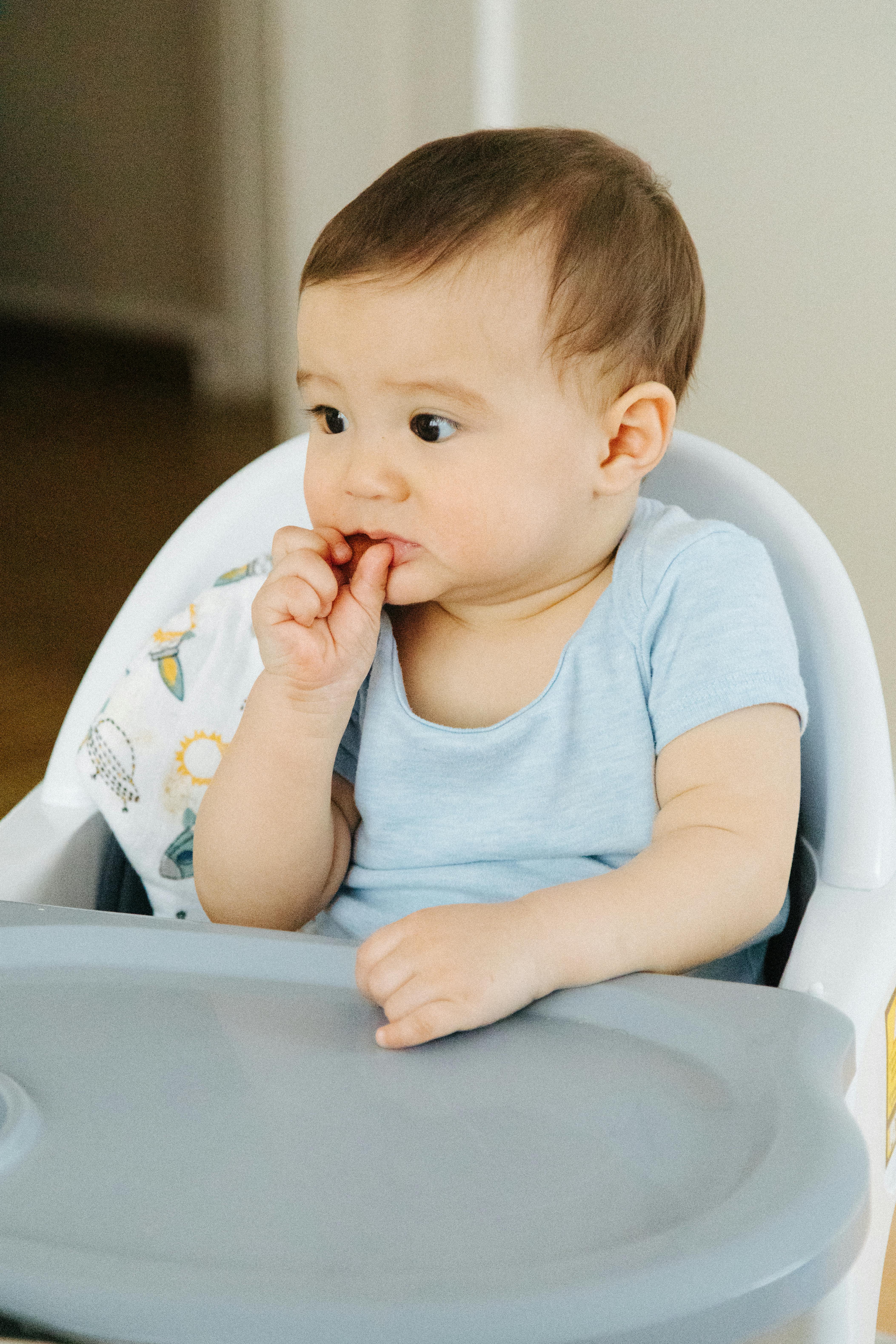
Before you can start feeding, you need somewhere safe to put the baby. A highchair with foot support, a five-point harness, and a position that keeps the baby upright is essential — a reclined position while eating is a choking risk. The guide to the best high chairs for babies starting solids covers the practical equipment questions in detail.
Purees vs. Baby-Led Weaning
Both approaches are legitimate, both are supported by the AAP, and both can be done safely when developmental readiness is confirmed. The choice between purees and baby-led weaning — or a combination of both — depends on your baby's personality, your comfort level, and your practical situation. The evidence on which is "better" is mixed enough that no universal recommendation is warranted. The detailed comparison of baby-led weaning and purees lays out what the research says and what the practical differences are in daily life.
Making the First Week Less Complicated
A few practical notes for the first feeds:
Timing matters: offer solids when the baby is in a good mood, not overtired or overhungry. A half-feed of breast milk or formula first so they're not starving, then offer the food with the rest of the milk feed after.
Start with one teaspoon to one tablespoon. The goal is experience, not calories. Most of it will end up on the baby's face, the bib, and the floor.
Give new foods several days apart in the early weeks, so you can observe for reactions. Once you've established a base of a dozen or so foods with no concerns, you can be more relaxed about timing.
Don't stress about rejection. It takes repeated exposure for most babies to accept a new food. What looks like strong refusal at feeding two might be enthusiastic acceptance at feeding nine.
The first six months of solid food are less about nutrition and more about building oral motor skills, learning to swallow, experiencing textures, and broadening food exposure. The calories and nutrients really start mattering more in the second half of the first year, when breast milk or formula intake typically begins to drop as solid food intake grows.
🌱 Discover Your Parenting Wellbeing Score
Get your personalised score across 9 dimensions and find articles curated for your stage.
Get My Score →Community comment
Sign in to join the conversation and share your parenting experiences.
Sign in with Google
No comments yet — be the first to share your thoughts! 💛