Teaching Letters, Numbers, and Colors at Home Before Preschool Starts
Weave letters, numbers, and colors into everyday play and conversation — preschool teachers care far more about curiosity than rote memorization.
Phase: Preschool · Topic: Schooling Advice · Type: Evergreen · Reading time: ~7 min
About 20 percent of children can recognize a few letters by age three — typically the ones in their own first name. If your child isn't among them, there is nothing wrong with them, and nothing wrong with you. If they are, that's not a signal to accelerate to flashcard drills. Either way, the question worth asking isn't "how much does my child know?" It's "am I helping them stay curious?"
Teaching letters, numbers, and colors at home before preschool starts generates enormous parental anxiety and surprisingly little clarity. The dominant framing tends toward two unhelpful extremes: drill the alphabet nightly, or dismiss any academic preparation as developmentally inappropriate. The research sits somewhere more practical than either camp.
What children actually need before preschool — and what they don't
NAEYC (the National Association for the Education of Young Children) is direct: you do not need to drill children with letters, numbers, and facts before school starts. What preschool teachers actually look for — and what research identifies as a genuine predictor of early learning success — is readiness to engage: curiosity, the ability to focus briefly, some familiarity with books, and enough emotional groundwork to cope in a group setting.
That said, letter and color recognition aren't irrelevant. They're simply not the high-stakes checklist most parents treat them as. A 2019 NAEYC assessment found that kindergarten teachers regularly receive children who cannot count past five or identify basic colors — children for whom a few months of relaxed home exposure would have made their first weeks of school significantly easier. The goal isn't mastery; it's familiarity.
Here's a realistic developmental picture:
- Colors: Most children start grasping color concepts around 18 months and can reliably name six to eight basic colors by age three. Confusing blue and green at three-and-a-half is normal, not a gap to fix.
- Letters: About 20% of three-year-olds recognize a handful of letters — nearly always from their own name. By four, most know more than half the capital alphabet. By five, around 30% know all 26 in both cases.
- Numbers: Number recognition develops faster than number comprehension. A child can recite "one, two, three, four, five" with zero understanding that five means a specific quantity of things. Both skills matter and develop separately.
The difference between recognition and comprehension is crucial and under-discussed. A child who can rattle off the alphabet song hasn't necessarily learned letters any more than a child who can sing a song in French has learned French. What preschool teachers need from a new student is the beginning of understanding — not performance.
Colors first: the foundation the other skills sit on
Color learning is the right place to start, and not just because it's easier. Sorting and categorizing by color is an early mathematics skill — the beginning of classification, which underpins numeracy and literacy alike. A child who can sort red toys from blue toys is developing the same cognitive muscle they'll use when grouping numbers or distinguishing letters with similar shapes.
The most effective approach is environmental, not instructional. You don't need color flashcards. You need to narrate the world. At meals: "Can you pass me the red apple?" At bath time: "The soap is white and the towel is yellow." At the park: "I see a brown dog and a black dog." This casual, repeated naming embeds color vocabulary through natural use, which is far more durable than memorization.
When your child gets a color wrong, the most effective response isn't correction — it's re-narration: "That's a beautiful purple, isn't it?" No drama, no quiz, just the correct word used naturally in context.
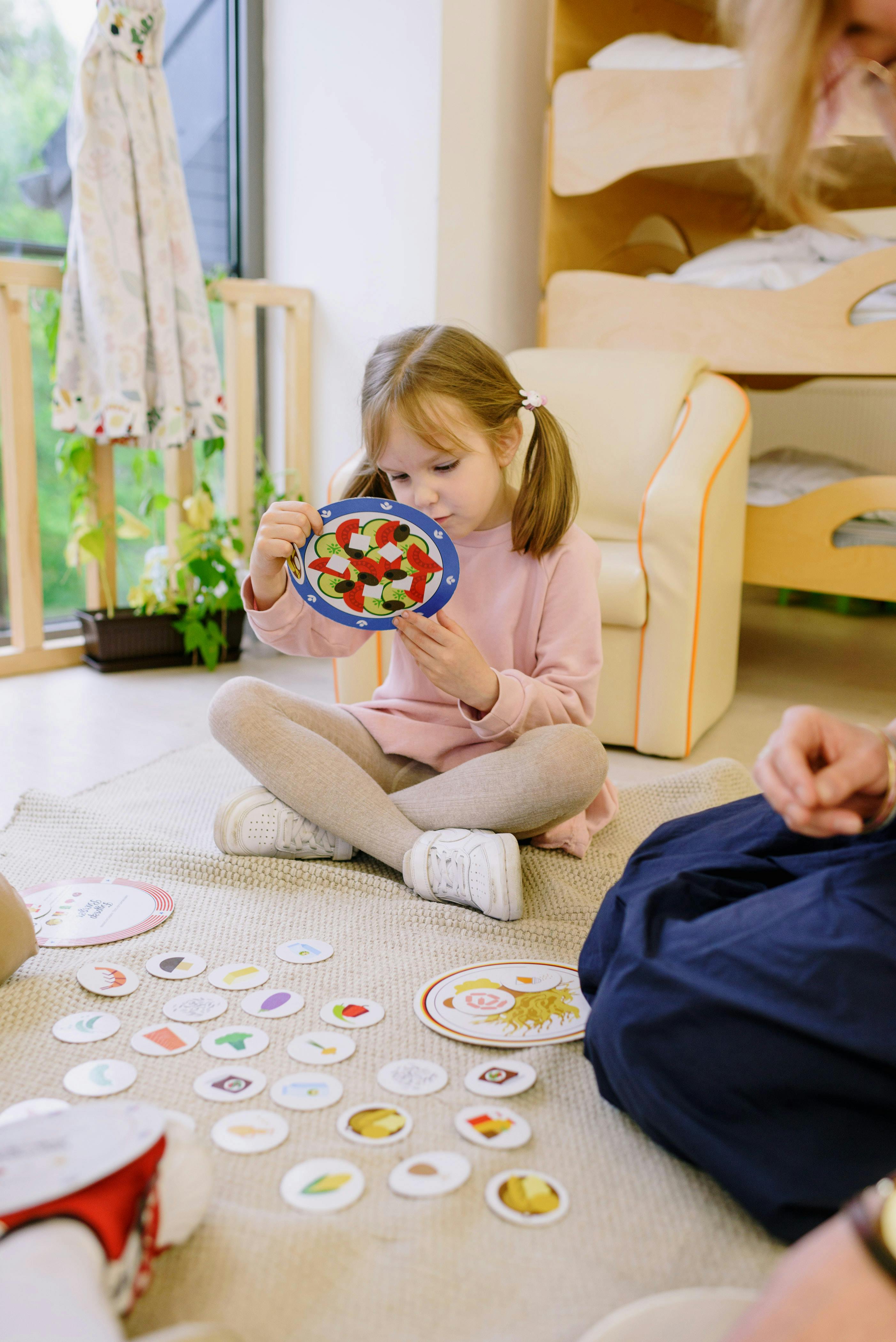
Sorting games are high-return and require no special materials. Sorting laundry by color, grouping crayons by shade, organizing blocks into piles — these feel like play to a preschooler and build exactly the categorical thinking that early math instruction will later depend on.
Letters: start with the name, then follow curiosity
Children almost universally learn the letters in their own name first, then the letters in names of people and things they care about. This is not a coincidence. Letters become meaningful when they attach to something that matters.
Start with your child's name. Write it, point to it in books, find it on signs. "That's an M — M is the first letter in Maya's name." By three-and-a-half to four, expand to siblings' names, familiar words on signs, their favorite book title.
A few tools that hold up better than flashcards:
Magnetic letters on the fridge. Not for drills — for play. Let your child rearrange them, hand you letters to stick up, "write" their name. The tactile, three-dimensional quality helps children remember letters far better than flat images on cards. They're also present at eye level during meals, which means passive repeated exposure without any formal session.
Letter-sound connections over letter names. Most early literacy specialists emphasize phonemic awareness — the connection between a letter's written form and the sound it makes — over knowing the letter's name. "B makes the buh sound, like ball and banana" is more useful preparation for reading than knowing the character is called "bee." Both matter; lead with the sound.
Books with clear text. When you read aloud, point to words occasionally. "This word says 'bear' — it starts with B, buh." Don't turn every reading session into a lesson — the love of books matters more than any specific skill. But one or two moments of pointing-to-text per session starts building the connection between spoken and written language that early reading depends on.
Worth knowing: Research published in 2024 found that even two weeks of structured letter-sound training produced measurable changes in brain white matter in preschoolers — but the training worked because it was multisensory and scaffolded, not intensive. The principle: a little, regularly, through multiple senses beats a lot in one format.
Numbers: recognition is the easy part
Number recognition comes quickly because numbers are everywhere — on clocks, remote controls, house numbers, cereal boxes. The skill that takes longer and matters more is number sense: understanding that "5" represents five actual objects, that five is more than four, that removing one from five leaves four.
Counting as a social ritual ("one, two, three!") is not the same as quantitative understanding, and parents often conflate them. The gap shows up when a child confidently says "one two three four five" while handing you three objects when asked for five. This is developmentally normal — and the bridge from ritual counting to real number sense is built through handling objects, not through seeing numerals written down.
For pre-preschool number foundations:
Count real things. Steps on the stairs. Blueberries on a plate. Socks to match. The counting should always involve touching or pointing to an object. This builds one-to-one correspondence — one number word, one object — which is the foundation of arithmetic.
Use more/less/same language. "Do you have more crackers or do I?" "Let's see if we have the same number of cups as people at the table." This comparative language is early number sense and requires knowing no numerals at all.
Point to numbers in the environment. The house number, the page number in a book, the number on a bus. Recognition comes naturally from varied, repeated exposure — no separate exercises needed.
A child entering preschool who can count five to ten objects with one-to-one correspondence and understands "more" and "less" is genuinely well-prepared. Knowing what a 7 looks like is a bonus, not a prerequisite.
The pressure problem
There's a real risk in turning pre-preschool learning into performance anxiety. Researchers in early childhood education have found that parental anxiety about numeracy and literacy can transmit to children, creating negative emotional associations with these skills before formal instruction even begins. The way you talk about letters and numbers signals to your child whether they're interesting, joyful things or sources of tension.
The most productive frame is genuine curiosity, not testing. "I wonder what letter that is?" lands differently than "What letter is that?" One is an invitation; the other is a quiz. At this age, invitation builds more than evaluation does.
If your child shows no interest in letters or numbers at three, that's completely normal. Interest in abstract symbols emerges at different times for different children. Keep the environment rich — books around, numbers visible, colors named, stories told — and the curiosity will come. For ideas on building a home reading habit with your preschooler, including which books actually hold a three-year-old's attention, our dedicated guide covers exactly that.
What a real week actually looks like
None of this requires a curriculum, a schedule, or a special purchase. Here's what an ordinary week of pre-literacy and pre-numeracy support actually looks like:
At breakfast, count the blueberries. At bath time, name the color of the towel and the cup. During a walk, spot letters on signs — especially the ones in your child's name. While reading together, pause once to point at a word and say what sound it starts with. While sorting laundry, ask your child to hand you the blue socks. During block play: "You made a tower with four red blocks."
That's it. No flashcards, no apps, no structured sessions. This is approximately the right amount of deliberate input for a child aged two to four — present enough to build familiarity, light enough that learning stays something they look forward to.
By the time your child starts preschool, they don't need to know all 26 letters or count to 20. They need to know that letters and numbers exist, that they mean something, and that finding them in the world is interesting. What preschool teachers actually look for — curiosity, language, emotional readiness — matters far more than any specific academic milestone. The letters and numbers will follow. Make sure the love of learning comes first.
🌱 Discover Your Parenting Wellbeing Score
Get your personalised score across 9 dimensions and find articles curated for your stage.
Get My Score →Community comment
Sign in to join the conversation and share your parenting experiences.
Sign in with Google
No comments yet — be the first to share your thoughts! 💛