Screen Time for Toddlers: What the Experts Say vs. What Real Parents Do
Screen time quality and context matter far more than the clock — but some risks from heavy, unstructured use are real and worth knowing.
Phase: Toddler · Topic: Parenting · Type: Evergreen · Reading time: ~8 min
Ninety-eight percent of two-year-olds watch screens on a typical day, for an average of just over two hours — more than double the one-hour daily limit that the World Health Organization recommends. A 2025 survey found that more than 74% of American parents feel guilty about their toddler's screen time regardless of its content or purpose. And yet almost none of them stop.
This is not a story about parents failing to follow good advice. It is a story about advice that was written for a world that no longer exists, trying to govern a behaviour that has become structurally embedded in family life. The more useful question is not "how do I get to one hour?" — it is "what does the research actually say is harmful, what is fine, and what should I genuinely change?"
What the Guidelines Actually Say (and What They Don't)
The American Academy of Pediatrics (AAP) current guidance, updated in 2026, recommends no screens before 18 months except for video calling, limited and co-viewed educational content for 18–24 months, and up to one hour of high-quality programming per day for ages 2–5. Critically, the AAP has moved away from treating screen time as a single monolithic category — the guidance now explicitly prioritises quality, context, and conversation over strict time limits.
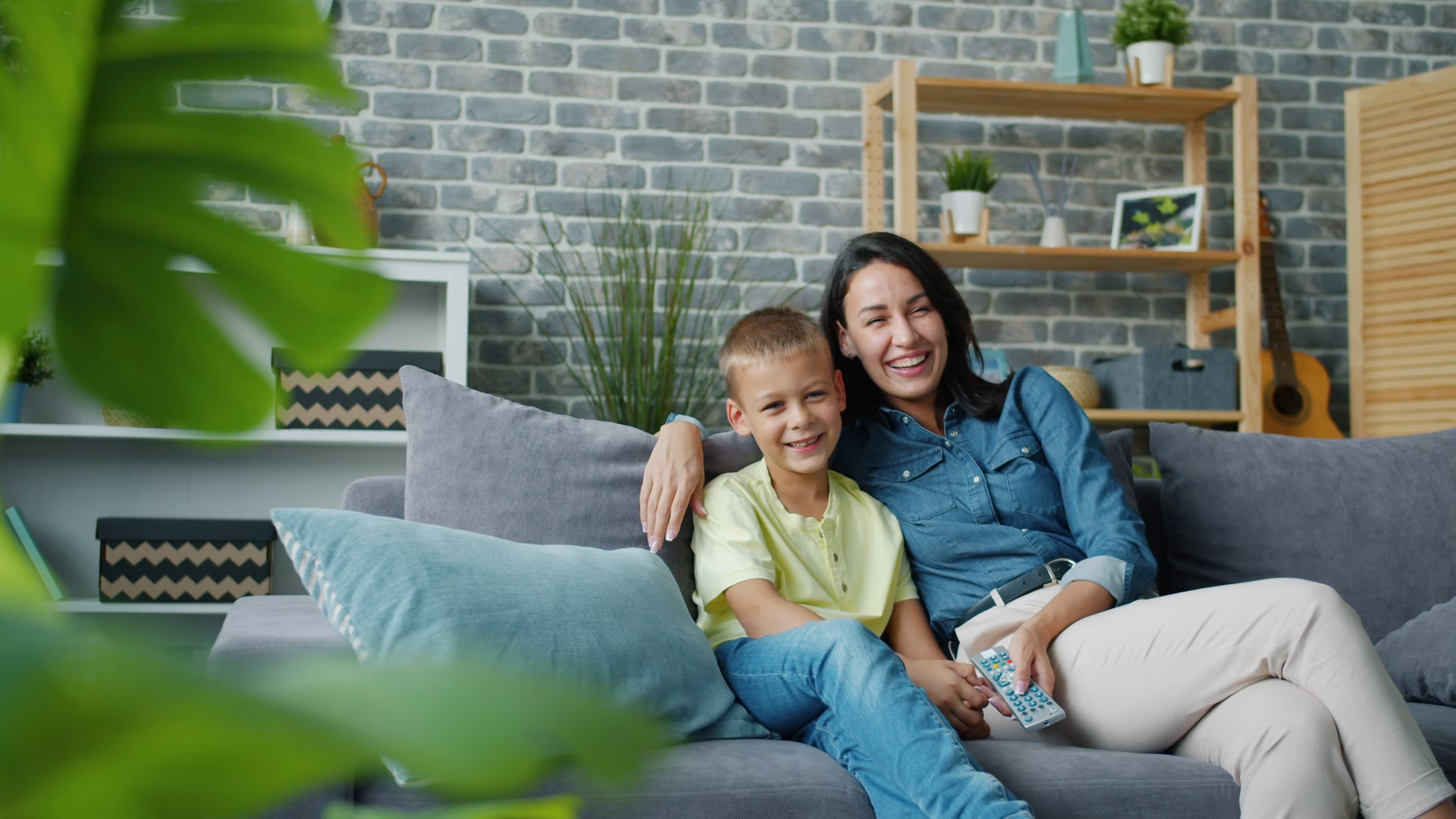
That shift matters. The research the guidelines are based on was conducted primarily on passive, background, unstructured screen use — a child watching TV alone while a parent is elsewhere. That context produces the clearest negative associations: language delays, reduced parent-child interaction time, disrupted sleep. It is not the same as a parent and toddler sitting together watching an episode of Sesame Street and talking about it.
The AAP's own researchers have noted that the evidence for a specific one-hour limit is not as strong as the clarity of the number implies. What the research does support consistently is this: heavy, unmediated screen use displaces the face-to-face interaction that drives language and cognitive development — and it is that displacement that causes harm, not the screen per se.
What the Research Actually Shows Is Harmful
Several findings from the research are robust enough to take seriously.
Language development and vocabulary. A 2023–24 UK study of more than 4,700 two-year-olds found that children in the highest screen-use group (averaging five hours per day) scored 12 percentage points lower on vocabulary tests than those in the lowest group (averaging 44 minutes). The association held after controlling for family income and parental education. Five hours is a long way from one hour, and the relationship appears to be non-linear — the bottom quartile of users showed no meaningful difference from the next quartile up. The concern is concentrated at the heavy end.
Background television. This is the finding parents most often overlook. Having the TV on in the background — even when no one is watching — measurably reduces the amount and quality of parent-child verbal interaction. When background TV is on, adults talk to their children less, and children's own vocalisations decrease. This effect is documented even in infants. If you are going to have screens on, watching a specific thing intentionally is better than having ambient noise running all day.
Sleep disruption. Screen use within an hour of bedtime — particularly on tablets or phones with blue-light-emitting displays — consistently delays sleep onset in young children. The mechanism is both the light exposure and the alerting effect of the content. This is one area where the advice translates directly to a concrete behaviour: a screen-free 30–60 minutes before bed is worth protecting, not as moralism but because sleep quality at this age matters for everything else.
Fast-paced fantastical content. A 2011 University of Virginia study found that just nine minutes of watching fast-paced cartoons produced measurable impairment in executive function in four-year-olds immediately afterwards. Follow-up research refined this: the key factor was not pacing alone but fantastical content — content that bears no relationship to how the real world works. This is why CoComelon, certain YouTube channels, and hyper-stimulating autoplay videos are a different proposition from Bluey or Daniel Tiger, even if the clock time is the same.
What Is Genuinely Fine (or at Least Not Proven Harmful)
Occasional longer sessions when a parent is exhausted. A 2024 study published in Greater Good found that parental guilt about screen time predicted higher parenting stress — and that higher stress predicted worse relationship quality with the child. The irony of the guilt is real: the emotional cost of feeling like you're constantly failing outweighs the developmental cost of an extra 30 minutes of Peppa Pig on a hard Tuesday.
Video calling with family. This is explicitly carved out of the "no screens" guidance for under-18-months for a reason. Video calling involves turn-taking, face recognition, emotional reciprocity, and conversational structure. It is not passive consumption; it is social interaction mediated by technology. A two-year-old who video-calls a grandparent weekly is having a qualitatively different experience than one watching an uninterrupted YouTube playlist.
Using screens as a genuine tool when you need a break. The 2025 Lurie Children's survey found that parents allow an average of 21 hours of weekly screen time when they believe nine hours is ideal. That gap exists because real life — single-parent households, work-from-home demands, illness, childcare gaps — creates genuine need for safe, low-effort containment. This is not moral failure. A child watching 45 minutes of age-appropriate content while a parent finishes a deadline or lies down with a migraine is not being harmed.
The Variables That Actually Move the Needle
If the research is clear on anything, it is this: the same amount of screen time produces very different outcomes depending on what, how, and with whom.
Content quality. Sesame Street has more than 50 years of research behind it demonstrating consistent benefits for language development and school readiness — it was designed by developmental scientists from the beginning. Daniel Tiger's Neighbourhood is structured around social-emotional learning and teaches specific emotional regulation strategies that toddlers demonstrably use. Bluey, while designed for slightly older children, models imaginative play and family relationships in ways that parents report sparring into real-life behaviour. PBS Kids as a platform has been specifically associated with improved executive functioning, partly attributed to its ad-free structure. These are not equivalent to autoplay YouTube content with bright colours and no discernible narrative purpose.
Co-viewing. Research across multiple studies shows that watching content alongside a child and talking about it — asking "what do you think will happen?" or "why is she sad?" — significantly improves learning outcomes compared to solo viewing of identical content. You do not need to do this every session, and you do not need to make it feel like a lesson. Commenting naturally on what you are watching together is enough.
Avoiding the autoplay loop. Platforms designed for adults — and YouTube, despite its Kids mode — are built around recommendation algorithms optimised for engagement, not child development. The content that keeps children most glued is often the content with the fastest pacing, the loudest sounds, and the least educational value. Choosing specific shows rather than handing over a device and walking away keeps you in control of what goes in.
A Practical Framework That Doesn't Require Perfection
The families who seem to handle this most successfully share a few common habits — none of which require meeting the one-hour guideline on a given day.
Screens off during meals and during the 30–60 minutes before bed. These two windows have the clearest evidence behind them and the most concrete mechanisms. Protecting them is more useful than agonising over the overall daily total.
Intentional selection over passive default. Pick what is watched before handing over the device. A library of downloaded episodes of known quality is better than an open tablet with autoplay enabled.
Use the TV more than the tablet. A show on a TV across the room is different from a phone six inches from a toddler's face. The proximity, the interactivity demands, and the autoplay behaviour differ enough to matter.
Connect screen content to real life when it naturally comes up. You do not need a formal debrief after every episode. If your child just watched Daniel Tiger deal with feeling left out and you notice something similar happening at the park, mentioning it briefly is how that learning transfers.
And on the question of guilt: a 2024 research study specifically found that parental screen guilt predicts higher parenting stress, which in turn reduces relationship quality with the child. The research, in other words, suggests that worrying about screen time may be doing more damage than the screen time itself — at moderate levels. That is not a licence for anything goes. It is a reason to direct your energy toward the things that actually matter — content quality, protecting sleep, maintaining conversation — rather than toward a daily minute-count that no research cleanly supports as the threshold for harm.
For indoor activity ideas that fill those offline hours without requiring enormous energy from a depleted parent, there are options that work at every budget and energy level. And if you are navigating toddler tantrums alongside the screen time battles, the research on both points in the same direction: connection and calm beat strict enforcement, almost every time.
🌱 Discover Your Parenting Wellbeing Score
Get your personalised score across 9 dimensions and find articles curated for your stage.
Get My Score →Community comment
Sign in to join the conversation and share your parenting experiences.
Sign in with Google
No comments yet — be the first to share your thoughts! 💛